Watch- Mohammad Nabi-Azmatullah Omarzai create Pakistan-like comical run out vs Australia
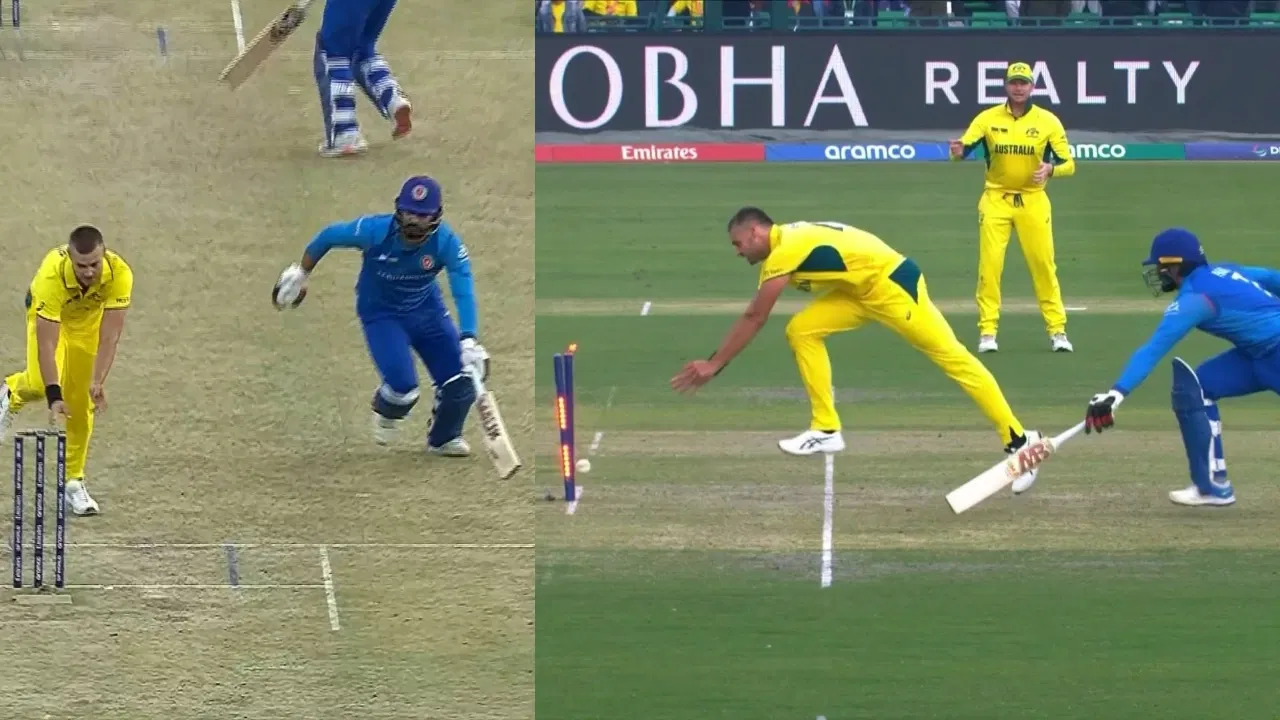
Afghanistan’s Mohammad Nabi Falls Victim to Unlucky Run-Out Against Australia in ICC Champions Trophy 2025
In a dramatic turn of events, Afghanistan’s all-rounder Mohammad Nabi fell prey to an unfortunate run-out during their crucial group match against Australia in the ongoing ICC Champions Trophy 2025. The incident took place on Friday, February 28, at the Gaddafi Cricket Stadium in Lahore.
It all unfolded when Australian pacer Spencer Johnson delivered a short ball down the leg side, causing wicketkeeper Josh Inglis to fumble while attempting to gather the ball cleanly. The deflection to his left prompted Azmatullah Omarzai and Mohammad Nabi to attempt a quick run, but Nabi was suddenly sent back midway. In a swift display of presence of mind, Inglis threw the ball towards the stumps, where Johnson reacted promptly, collecting the ball and dislodging the bails. This led to Mohammad Nabi being caught short of his crease, resulting in an easy wicket for Australia.
Mohammad Nabi’s Early Departure
The unfortunate run-out saw Mohammad Nabi heading back to the pavilion after facing just one delivery, scoring a single run. Notably, at 40, Nabi is the oldest player competing in the Champions Trophy this year.
Speaking about the high-stakes match, Afghanistan’s captain Hashmatullah Shahidi won the toss and chose to bat first against Australia in their final group-stage encounter. The outcome of this match holds significant importance for the Afghan side, as a triumph over the two-time champions would secure them a spot in the semi-finals.
Afghanistan’s Remarkable Journey in the Tournament
After a challenging start with a heavy defeat against South Africa, Afghanistan bounced back brilliantly with a thrilling eight-run victory over England, eliminating the 2019 World Cup champions from the tournament. This win marked their second triumph over England in an ICC event, following their memorable 69-run victory in the 2023 World Cup.
With their semi-final hopes hanging in the balance, Afghanistan’s batters put up a stellar performance to set a target of 273 against Australia in Lahore. Notable contributions came from Sediqullah Atal, who scored 85 runs off 95 balls, and Azmatullah Omarzai, who managed 67 runs off 63 balls. Sediqullah formed two crucial partnerships of over 60 runs each with Ibrahim Zadran and Hashmatullah Shahidi at the Gaddafi Cricket Stadium. For Australia, bowlers Spencer Johnson and Adam Zampa claimed two wickets each against Afghanistan.
Pre-Match Insights and Australian Controversy
Prior to the match, Captain Hasmatullah Shahidi expressed confidence in their decision to bat first, citing the deteriorating pitch conditions that could favor their spinners in the second innings. He mentioned that Afghanistan had analyzed their previous game against England and had devised strategies to rectify their mistakes against Australia.
It is worth noting that Australia and Afghanistan have only faced off in ICC events, as Cricket Australia has declined bilateral series with Afghanistan due to concerns over the humanitarian crisis under Taliban rule. Australia’s stance against the treatment of girls and women by the Taliban has led to a strained relationship between the two cricketing nations.
Overall, Afghanistan’s journey in the ICC Champions Trophy 2025 has been filled with ups and downs, showcasing their resilience and determination to compete at the highest level of international cricket.
Impact of Mohammad Nabi’s Run-Out on Afghanistan’s Innings
The dismissal of Mohammad Nabi through a run-out early in Afghanistan’s innings proved to be a significant setback for the team. Nabi, known for his experience and composure in pressure situations, was expected to anchor the innings and provide stability in the middle order. His departure so early in the match meant that Afghanistan lost a crucial wicket and a key player who could have steered the team towards a competitive total.
Furthermore, the run-out also exposed the vulnerability of Afghanistan’s lower middle-order, highlighting the need for the remaining batsmen to step up and fill the void left by Nabi’s departure. The pressure was now on the likes of Ibrahim Zadran, Hashmatullah Shahidi, and the lower-order batsmen to consolidate and build partnerships to post a challenging total against a strong Australian bowling attack.
Afghanistan’s Bowling Strategy and Spin Options
As mentioned by Captain Hashmatullah Shahidi, Afghanistan’s decision to bat first was influenced by the conditions of the pitch, which were expected to deteriorate and assist the spinners in the second innings. Afghanistan boasts a formidable spin attack, with the likes of Rashid Khan, Mujeeb Ur Rahman, and Mohammad Nabi capable of exploiting the turning tracks to put pressure on the opposition batsmen.
With a target of 273 set by Afghanistan, their spin bowlers would play a crucial role in defending the total and putting Australia under pressure during their chase. The team’s success would heavily depend on how effectively their spinners could control the flow of runs, pick up key wickets, and apply pressure on the Australian batsmen in the crucial knockout match.
Australia’s Response and Batting Lineup
After restricting Afghanistan to 273 runs, Australia’s batting lineup faced the challenge of chasing down the target in a high-pressure knockout match. Led by captain Travis Head and experienced batsmen like Josh Philippe and Cameron Green, Australia’s top order was expected to provide a solid foundation for the chase.
However, Afghanistan’s spinners posed a threat to Australia’s batting lineup, and the team would need to navigate the tricky conditions and counter the spin challenge to secure a place in the semi-finals. The contest between Afghanistan’s spinners and Australia’s batsmen promised to be a gripping battle, with both teams vying for a spot in the next stage of the tournament.
International Relations and Cricket Diplomacy
The strained relationship between Australia and Afghanistan off the field due to geopolitical reasons added an extra layer of significance to their encounters in ICC events. Cricket, often seen as a bridge between nations and cultures, found itself entangled in the broader political context, reflecting the complexities of international relations.
Despite the tensions between the two nations, their on-field battles showcased the spirit of competition and sportsmanship, highlighting the power of cricket to transcend boundaries and unite people through a shared love for the game. The cricketing rivalry between Australia and Afghanistan served as a reminder of the broader social and political issues that sometimes influence the world of sports.
Conclusion
As Afghanistan and Australia continued their intense battle in the ICC Champions Trophy 2025, the match unfolded as a testament to the unpredictable nature of cricket, where every run, wicket, and decision could sway the outcome of the game. Both teams displayed determination, skill, and sportsmanship in pursuit of victory, showcasing the essence of cricket as a fiercely competitive yet unifying sport.
Whether Afghanistan could defend their total and secure a semi-final berth or if Australia could chase down the target and advance in the tournament, the match between the two teams symbolized the spirit of cricket as a platform for talent, resilience, and camaraderie on the global stage.
Latest News

“Mumbai Indians are winning it” – Ex-England captain makes bold prediction for IPL 2026

Mayank Yadav reveals real story behind his recovery and Sanjiv Goenka’s support
IPL 2026 ball change rule explained
Ottis Gibson reveals plan to revive Babar Azam’s confidence ahead of PSL 2026

Liam Livingstone survives as Rob Key confirms England spot after shocking interview claims

Kevin Pietersen credits RCB and IPL for career revival

Ottneil Baartman set to join CSK in IPL 2026 as replacement of….

“Great news for IPL”: Sourav Ganguly reacts to Rajasthan Royals being sold for staggering $1.63 billion

NZ vs SA 5th T20I Preview: Free Live Streaming, Pitch & Weather Report, Head-to-Head | South Africa tour of New Zealand 2026
NZ vs SA Match Prediction – Who Will Win 5th T20I? | South Africa tour of New Zealand 2026

New Zealand Playing XI vs South Africa Playing XI – 5th T20I | South Africa tour of New Zealand 2026
PBKS spinner calls Virat Kohli his idol, makes bold dismissal claim ahead of IPL 2026

“Not stupid”: Adam Gilchrist, Mark Waugh break silence on ECB not sacking Brendon McCullum

Revealed: Why RCB players will wear black armbands and No.11 jersey in IPL 2026?