

Waqar Younis compares Babar Azam to Sachin Tendulkar while defending him
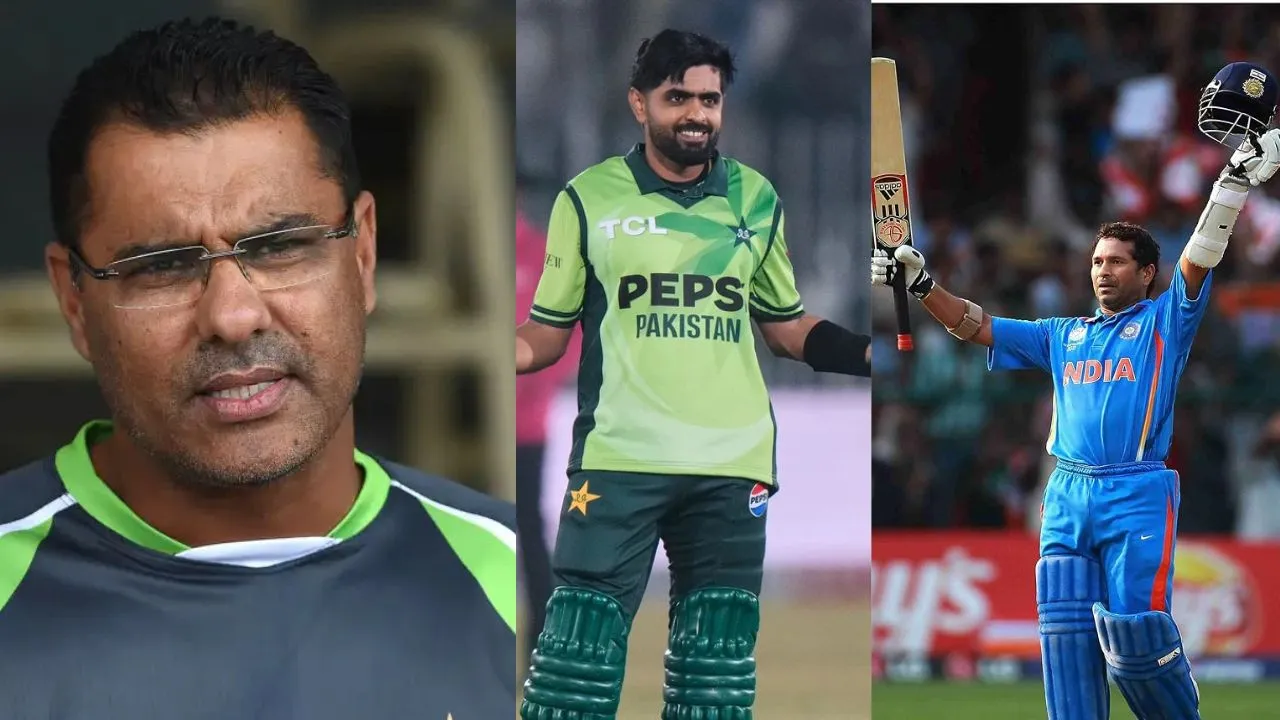
Waqar Younis Backs Babar Azam, Says Pakistan’s Star Needs More Support
Former Pakistan captain and fast-bowling great Waqar Younis has offered a supportive assessment of Babar Azam, describing him as one of the country’s current cricket superstars and suggesting that his performances could look very different with stronger batting support around him. Waqar also named left-arm quick Shaheen Afridi as a leading star of Pakistan cricket, even as both players face scrutiny over their recent form.
Speaking on Shubhankar Mishra’s YouTube channel, Waqar was asked who he considered Pakistan’s most recent superstar. Rather than pointing only to past icons, he identified Babar and Shaheen as the modern players carrying that status. His comments arrive at a challenging time for Pakistan, whose results and individual performances have drawn criticism, but whose team has still reached the final of a home tri-series featuring Sri Lanka and England.
Waqar’s Babar Azam and Sachin Tendulkar Comparison
Waqar’s comparison between Babar and Sachin Tendulkar was not simply about statistics or playing style. Instead, he focused on the importance of a dependable batting line-up. In his view, Babar has often carried a heavy share of responsibility for Pakistan, while Tendulkar played alongside several established Indian batters during different stages of his career.
“The sad part with Babar Azam is that he doesn’t have anyone from the other end,” Waqar said, arguing that the story might be different if Babar had four major batting names around him. He pointed to players such as Rahul Dravid, Sourav Ganguly, VVS Laxman and Virender Sehwag, who provided India with experience and depth during Tendulkar’s career. Earlier in Tendulkar’s international journey, Sanjay Manjrekar was also among the recognised batters in the side.
Waqar recalled that Pakistan’s teams in the 1990s could call on several match-winners throughout their top six. He believes the present side does not have the same concentration of proven batting options. “In the 90s, we in Pakistan had six match-winners in our top six. But now, we have just one: Babar Azam,” he said.
The observation highlights a wider issue for Pakistan: when a team relies heavily on one high-profile batter, opponents can build plans around that player, and a failure at the top can quickly leave the middle order under pressure. A more consistent group of contributors would not only ease the burden on Babar but also give the side greater flexibility in setting totals and chasing targets.
Recent ODI Form Adds Pressure
Waqar’s praise comes against the backdrop of a difficult run for Babar in one-day cricket. During the ongoing tri-series, he has scored 118 runs at an average of 29.50, with 45 his highest score. Those numbers are below the level expected of a batter of his standing, particularly in a tournament where Pakistan are seeking to build confidence ahead of future white-ball assignments.
His recent ODI innings have also lacked a half-century. In Pakistan’s latest match against Sri Lanka, the batting line-up was dismissed for 110, and Babar was the team’s leading scorer with 29. That total underlined how much the side needs partnerships and contributions across the order, rather than relying on one player to rescue an innings.
Across 12 innings in the 2025–26 season before that 29-run effort, Babar had made 424 runs at an average of 35.33, including a highest score of 102 not out. The century showed that he remains capable of producing a substantial innings, but the overall return has been inconsistent by the standards he has set for himself. His last half-century in the format came against Australia in May, adding to the focus on whether he can rediscover his rhythm.
Why Pakistan Needs More Than Individual Form
Babar’s role in the side is central, but Pakistan’s batting challenges cannot be reduced to one player’s scores. Strong international teams generally need multiple batters capable of absorbing pressure, rotating the strike and accelerating when conditions allow. If the top order loses wickets early, the middle order must be able to rebuild without leaving the team short of runs at the end.
That is the context behind Waqar’s remarks. His point was not that Babar should be judged only by the quality of his teammates, but that a stronger supporting cast could help Pakistan get more from its leading batter. It could also reduce the pressure that comes with being treated as the side’s primary source of stability in nearly every innings.
For Babar, the immediate challenge is to turn promising starts into longer contributions and regain the consistency that made him one of Pakistan’s most dependable run-scorers. For the team, the task is broader: develop reliable partnerships and identify players who can share responsibility when the leading batter is dismissed or out of form.
Tri-Series Final Offers a Chance to Reset
Despite their uneven performances, Pakistan have reached the final of the home tri-series and will face Sri Lanka for the title. The match gives the hosts an opportunity to finish the tournament strongly, improve their momentum in white-ball cricket and test their batting plans under pressure.
A final is also a useful stage for a team to assess its balance. Pakistan will want contributions from more than just its headline names, while Babar will be keen to produce an innings that steadies the side and answers questions about his current ODI form. Shaheen Afridi, whom Waqar also called a superstar, remains another key figure whose impact can shape Pakistan’s fortunes with the ball.
Waqar’s prediction, in effect, is that Babar’s potential should not be measured in isolation from the team around him. The former fast bowler sees him as a genuine star, but believes Pakistan need a deeper group of match-winners to make that talent count consistently. Whether the tri-series final marks a turning point will depend not only on Babar’s performance, but on how well the entire batting unit shares the responsibility.
Latest News
Gautam Gambhir approached by 4 IPL franchises for 2028 season
Tilak Varma reveals secret behind his growing leadership skills ahead of IND vs NZ 4th T20I

Smriti Mandhana reveals MS Dhoni’s special WhatsApp message after World Cup triumph

R Ashwin explains why Hardik Pandya could be a perfect fit for KKR ahead of IPL 2027
Temba Bavuma achieves rare Test milestone at 36, becomes South Africa’s second-oldest to 4,000 runs
Virat Kohli’s name comes up in Supreme Court hearing on Diwali celebration

IND vs NZ Playing 11 Today, Live Streaming, Pitch & Weather: India tour of New Zealand 2026, 4th T20I
Litton Das’ injury vs WI: Bangladesh provide update on wicket-keeper batter

Shubman Gill ranked above Ronaldo-Messi in most marketable athletes list, Dhoni-Kohli-Rohit totally snubbed

Josh Inglis becomes first Australian to achieve this historic milestone

BCCI hints at WPL expansion as Devajit Saikia reveals plans for more teams

T Dilip to join Mumbai Indians ahead of IPL 2027: Report

“It is quite jarring” – Kumar Sangakkara makes serious allegations against Ryanair Staff at Dublin airport

Tilak Varma reveals Gautam Gambhir’s warning during New Zealand tour

