

7.50 average! Rohit Sharma endures worst-ever ODI series ahead of 2027 World Cup
Rohit Sharma’s New Zealand ODI Struggles Raise Questions Ahead of 2027 World Cup
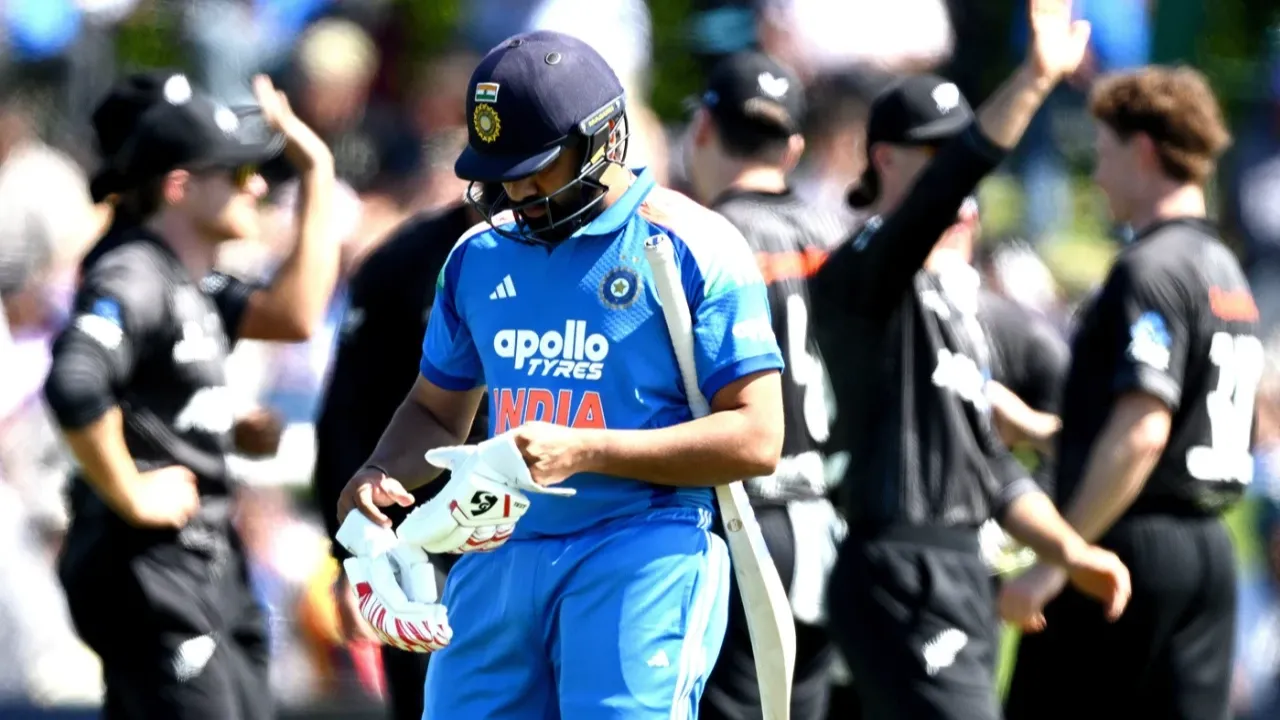
Rohit Sharma’s difficult New Zealand tour has put fresh attention on his form and role at the top of India’s ODI batting order. The former India captain managed only 30 runs across four innings, averaging 7.50, as India’s senior batters struggled to find consistency in challenging overseas conditions. The run of low scores has prompted questions about what India should expect from Rohit as preparations for the 2027 ODI World Cup continue.
The series also offered a reminder that a player’s recent record can shift quickly. Rohit arrived after a productive stretch in 2026, including a century against England and scores of 101 and 92 against the West Indies. Yet New Zealand’s bowlers repeatedly found ways to test him early, leaving little opportunity for him to settle or build an innings.
Rohit Records His Lowest ODI Series Average as an Opener
Rohit’s average of 7.50 was his lowest in an ODI series as an opener, among series involving at least four innings. His previous low marks in that category were 2.5 against Sri Lanka in 2012 and 9.8 against South Africa in 2018. In New Zealand, two of his four innings ended without scoring.
Kyle Jamieson dismissed Rohit for a six-ball duck at Eden Park, while Matt Henry removed him with the first delivery he faced at Mount Maunganui. Rohit’s best contribution came in Wellington, where he made 23 from 28 balls. He showed some intent in that innings but could not turn his start into a substantial score.
His final outing brought another early departure. Facing Matthew Fisher, Rohit tried to work a length ball towards the leg side, but the shot lacked control and went straight to Dean Foxcroft at mid-wicket. Rohit made seven from 13 deliveries, extending a series in which New Zealand’s bowlers regularly prevented him from establishing his preferred rhythm.
The figures are striking, but they need to be viewed alongside his broader record. Rohit remains one of India’s most experienced ODI batters and their second-highest run-scorer in the format since the 2023 World Cup. His strong performances earlier in 2026 also suggest that the New Zealand series may be a troubling dip rather than a complete loss of form. The key question is how quickly he can respond.
Early Wickets Put India Under Pressure
India’s top order faced immediate pressure in the final ODI after New Zealand captain Mitchell Santner won the toss and chose to bowl. It was Santner’s first toss victory in 10 matches on the tour, and he used the opportunity to put India’s batters under pressure with the new ball.
Matthew Fisher struck first, removing Rohit before dismissing Virat Kohli for five with a catch behind the stumps. Jacob Duffy then sent Ruturaj Gaikwad back for 18. A fuller wobble-seam delivery drew an inside edge, and wicketkeeper Tim Seifert completed a diving catch to his left. India were 37 for three inside the opening 10 overs.
The start underlined how quickly conditions can shape an ODI innings. New Zealand’s seamers found movement and made India’s batters play, while the visitors were unable to convert early caution into a stable partnership. The collapse was particularly notable after India had been bowled out for 89 while chasing New Zealand’s 334 in the fourth ODI, a 244-run defeat that had already intensified scrutiny of the batting line-up.
India entered the final match leading the series 2-1, with the chance to secure their first ODI series win in New Zealand since 2019. The hosts, meanwhile, were aiming to level the contest and protect their unbeaten home record against India since that tour. India also made changes for the match, handing Yash Thakur his ODI debut and recalling Mohammed Siraj, while New Zealand brought in Jacob Duffy and Blair Tickner.
World Cup Preparation Brings Bigger Questions
India’s heavy defeat in the fourth ODI raised concerns beyond the result itself. Head coach Gautam Gambhir said the conditions were a useful warning ahead of the 2027 World Cup, which is scheduled to be played in South Africa, Zimbabwe and Namibia. Those venues can offer pace, bounce and other challenges that differ from the conditions India often encounter at home.
Rohit’s form is only one part of the issue. Kohli began the series with 74 but then recorded scores of seven, zero and five across his next three innings. When two experienced members of the top order struggle at the same time, the burden shifts to the middle order and lower order to repair the innings. That can leave India vulnerable, particularly when wickets fall in clusters.
For team management, the series is therefore a chance to assess more than individual technique. India will need to consider how the opening pair handles movement, how quickly the middle order can stabilise a collapse, and whether the batting line-up has enough flexibility for different conditions. With the 2027 tournament still ahead, there is time to make adjustments—but performances in difficult away conditions remain valuable evidence for selection and planning.
Upcoming Sri Lanka Series Offers Rohit a Chance to Reset
India’s next home ODI series against Sri Lanka is expected to provide Rohit with an opportunity to rebuild confidence. The first match is scheduled for December 13 in Visakhapatnam, followed by games in Bengaluru on December 16 and Ahmedabad on December 19. Familiar conditions may help him regain fluency, though the broader challenge will be carrying that form into away matches.
Any prediction about Rohit’s long-term prospects should account for both sides of the picture: his recent run of low scores and his proven ability to produce major ODI innings. The New Zealand tour has highlighted areas India must address, but it does not erase his past contributions or the strong form he showed earlier in the year. His response in the coming matches will be closely watched—not only as a measure of his confidence, but also as one indicator of India’s progress towards building a reliable batting unit for the 2027 World Cup.
Latest News

SA vs BAN Playing 11 Today, Live Streaming, Pitch & Weather: South Africa tour of Bangladesh 2026, 2nd Test

AUS vs ENG Playing 11 Today, Live Streaming, Pitch & Weather: England tour of Australia 2026, 2nd T20I

Blair Tickner ruled out of 2nd Test vs India, replacement named

Tim Paine and Justin Langer face fresh questions over Australia’s ball-tampering scandal

India tour of Bangladesh gets fresh hope as BCB confirms talks with BCCI

Tom Latham opens up on soft ball problem and saliva ban after draw against India

Ajinkya Rahane slams Tilak Varma for publicly criticising Shahbaz Ahmed after India A’s defeat

ICC to introduce IPL-style bat checks in international cricket

“Smiling Laughing doesn’t happen”: R Ashwin’s dig at India’s approach after draw vs New Zealand

“Not good enough for Test cricket”: Scott Styris, Sunil Gavaskar slam Wellington pitch

Dodda Ganesh declares India ‘out of WTC final race’ after Wellington Test draw

Ajinkya Rahane criticises Shubman Gill for abusing Akash Deep in 1st Test vs New Zealand

‘Why so many boundary riders?’ Dinesh Karthik questions Shubman Gill’s captaincy after Wellington Test

“I just want to enjoy my life”: Yash Dayal reflects on his return to cricket


