

Glenn Phillips escapes scary head injury after Akash Deep’s powerful throw in 1st IND vs NZ Test
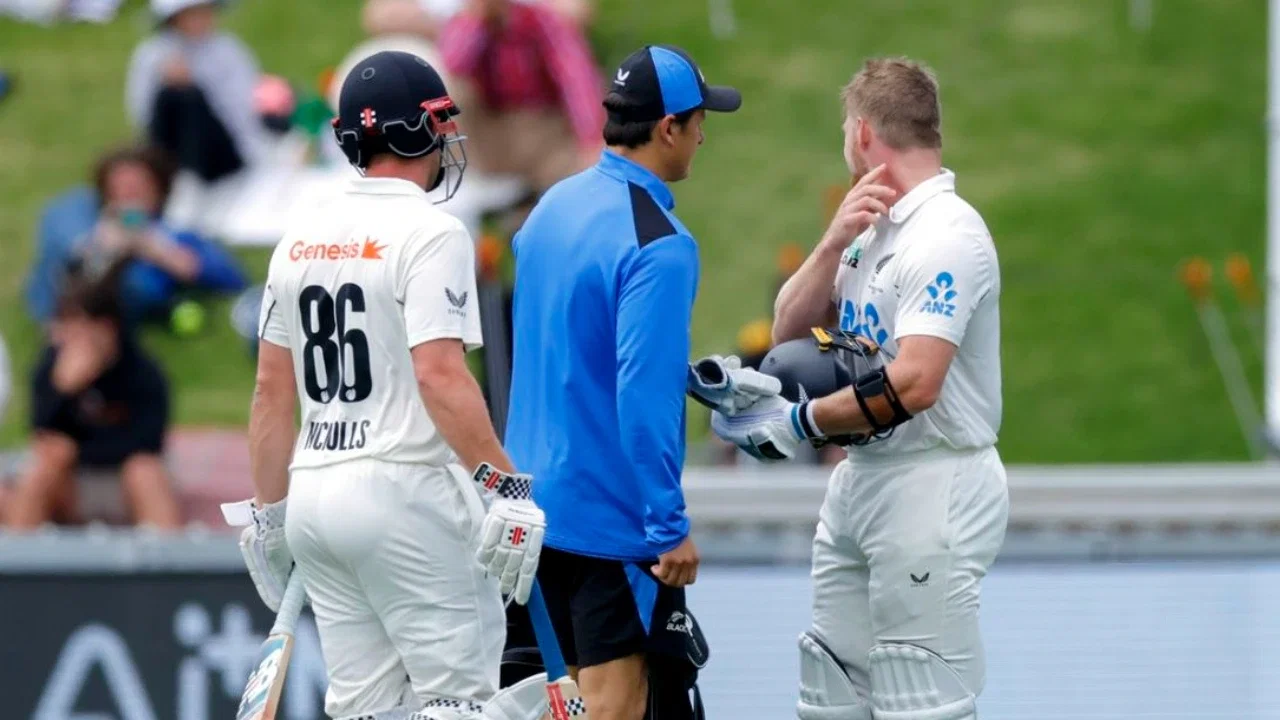
Glenn Phillips Makes History After Helmet Scare in New Zealand vs India Test
New Zealand batter Glenn Phillips produced a remarkable innings against India in the first Test at Wellington’s Basin Reserve, overcoming a frightening on-field incident before reaching a historic century. Phillips was struck on the helmet by a throw from Indian fast bowler Akash Deep during the second day’s play, but after a brief medical check, he returned to the crease and went on to score 118.
The blow briefly interrupted a compelling contest between the two sides. Phillips’ century not only strengthened New Zealand’s first-innings total but also established a rare international record: he became the first player to score a hundred against India in Tests, one-day internationals and T20 internationals within the same calendar year.
Akash Deep’s throw strikes Phillips’ helmet
The incident took place during the 85th over of New Zealand’s first innings, as Phillips attempted to complete a quick single. Akash Deep gathered the ball and threw it towards the bowler’s end in an effort to run the batter out. The throw missed the stumps and struck the side of Phillips’ helmet, close to his ear.
Phillips immediately removed his helmet, prompting play to stop while he was assessed. Akash Deep apologised, and New Zealand’s medical staff came onto the field to check for signs of concussion or other injury. Phillips was cleared to continue after the examination and appeared able to resume without further difficulty.
A helmet can reduce the danger of a direct blow, but an impact near the ear or side of the head is still taken seriously in professional cricket. Medical checks are a routine safeguard, allowing players and officials to look for symptoms that may not be immediately obvious. Phillips’ decision to pause and be assessed was therefore an important part of the response, even though he was able to carry on.
A century that reshaped the match—and the record books
Phillips began the second day on 94 and reached his century from 193 balls. He eventually made 118 from 216 deliveries, striking 14 fours. His innings was built through patience and timing, helping New Zealand recover after a difficult opening day in which the hosts had lost five wickets for just 70 runs.
The landmark also delivered a significant prediction-defying moment in the match: Phillips had looked set for a challenging day after the helmet incident, yet he continued to build his innings and reached a milestone that had never previously been achieved against India in a single calendar year. His three-format record reflects both his adaptability and the range of challenges posed by India’s bowling across international cricket.
Phillips had already scored centuries against India in the limited-overs formats during the year. By adding a Test hundred, he became the first cricketer to reach three international hundreds against the same opponent across Tests, ODIs and T20Is in one calendar year. Rohit Sharma had previously recorded a comparable achievement against Sri Lanka in 2017, scoring centuries against them in all three formats during that year.
Other players, including West Indies batter Shai Hope, have scored hundreds against India across all three formats over the course of their careers. Phillips’ distinction is the timing: he completed the set in one calendar year, making the achievement especially rare.
Phillips and Nicholls rebuild New Zealand’s innings
Phillips’ contribution was central to New Zealand’s recovery. After the early collapse, he joined Henry Nicholls in a decisive sixth-wicket partnership worth 216 runs. The stand shifted the pressure back onto India and gave the home side a strong platform from which to build a competitive first-innings total.
Nicholls was the more prolific scorer, finishing with 175 from 335 balls, including 21 fours. His long innings provided stability, while Phillips supplied valuable support and capitalised on scoring opportunities as the partnership grew. Together, they transformed New Zealand’s position from a precarious one into a commanding recovery.
Akash Deep eventually brought the stand to an end in the 94th over, bowling Phillips for 118. The dismissal gave the Indian attack a much-needed breakthrough, but the damage had already been done: New Zealand had added a substantial number of runs and forced India’s bowlers to work hard for every wicket.
India fight back to dismiss New Zealand for 368
Despite the partnership, New Zealand could not maintain its momentum after Phillips departed. The lower order offered limited resistance, and the hosts were eventually bowled out for 368. India’s bowlers shared the workload, with Jasprit Bumrah leading the attack by taking four wickets.
Akash Deep claimed three wickets, adding Phillips’ dismissal to his contribution with the ball, while Anshul Kamboj finished with two. The figures underlined India’s ability to respond after the substantial sixth-wicket stand, although the tourists had to wait patiently for the breakthrough that ended the partnership.
Why Phillips’ innings matters
Phillips’ performance stood out for more than its statistical milestones. He showed composure after a potentially unsettling blow, remained focused through a long partnership and helped rescue New Zealand from an early collapse. His century also offered a reminder of how quickly a Test match can change: a side under pressure can regain control through one substantial stand.
For New Zealand, the innings provided valuable runs and momentum. For India, the late recovery with the ball limited the hosts to 368, but the visitors still had to contend with a total shaped by Phillips and Nicholls. As the Test progressed, their partnership and Phillips’ historic hundred became defining moments of the opening innings.
Latest News

SA vs BAN Playing 11 Today, Live Streaming, Pitch & Weather: South Africa tour of Bangladesh 2026, 2nd Test

AUS vs ENG Playing 11 Today, Live Streaming, Pitch & Weather: England tour of Australia 2026, 2nd T20I

Blair Tickner ruled out of 2nd Test vs India, replacement named

Tim Paine and Justin Langer face fresh questions over Australia’s ball-tampering scandal

India tour of Bangladesh gets fresh hope as BCB confirms talks with BCCI

Tom Latham opens up on soft ball problem and saliva ban after draw against India

Ajinkya Rahane slams Tilak Varma for publicly criticising Shahbaz Ahmed after India A’s defeat

ICC to introduce IPL-style bat checks in international cricket

“Smiling Laughing doesn’t happen”: R Ashwin’s dig at India’s approach after draw vs New Zealand

“Not good enough for Test cricket”: Scott Styris, Sunil Gavaskar slam Wellington pitch

Dodda Ganesh declares India ‘out of WTC final race’ after Wellington Test draw

Ajinkya Rahane criticises Shubman Gill for abusing Akash Deep in 1st Test vs New Zealand

‘Why so many boundary riders?’ Dinesh Karthik questions Shubman Gill’s captaincy after Wellington Test

“I just want to enjoy my life”: Yash Dayal reflects on his return to cricket


