

“Like batting on a trampoline” – Daryl Mitchell opens up on Wellington pitch in 2nd ODI vs India
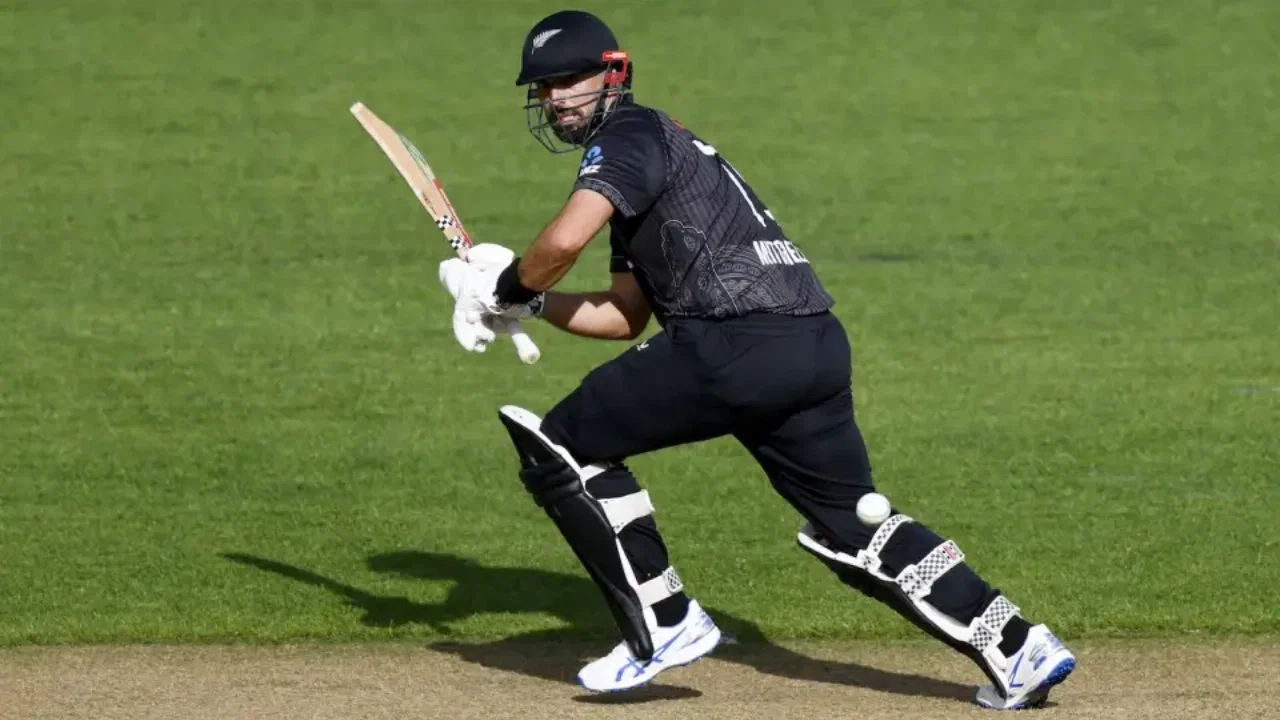
Daryl Mitchell Says Basin Reserve Pitch Bounced Like a “Trampoline” as New Zealand Are Bowled Out for 134
New Zealand batter Daryl Mitchell described the Basin Reserve surface as unusually difficult to read after the hosts were dismissed for 134 in the second ODI against India in Wellington. Mitchell, who top-scored with a determined 55, said inconsistent bounce and the challenge of rotating the strike made it hard for New Zealand to build lasting partnerships.
Rain delayed the start and reduced the match to 47 overs per side. India captain Shubman Gill won the toss and chose to bowl, a decision that paid off as his attack made effective use of the conditions. New Zealand’s batters struggled to settle, while India’s bowlers kept the pressure on throughout the innings.
Mitchell Compares the Wellington Surface to a Trampoline
Speaking to broadcaster Simon Doull during the mid-innings break, Mitchell said the ball did not come through at a consistent height. The uncertainty made it difficult for batters to commit to shots or judge whether they could safely take a quick single.
“It’s pretty challenging out there,” Mitchell said. “It was like batting on a trampoline at times. We weren’t quite sure what height the ball was going to come through at.”
Mitchell added that New Zealand had hoped to post a substantially bigger total, but the conditions made scoring difficult. The pitch was a drop-in surface, and he said the lack of adjacent pitches affected how the ball behaved when batters tried to work it into gaps and run.
“All of us found it really hard to rotate the strike,” he explained. “When you add that to the bounce, sometimes the only option was to try and give it a hoick and see what happens.”
His comments offered a useful glimpse into the challenge facing the New Zealand lineup. On a surface with unpredictable bounce, even routine defensive shots can become uncertain, while attempts to manufacture singles carry extra risk. India’s disciplined bowling compounded that difficulty by limiting easy scoring opportunities.
New Zealand Wanted to Build Partnerships
Mitchell said the team’s intention was not simply to attack. He tried to play to his strengths and respond to the plans being used by India’s bowlers, while also looking for opportunities to extend partnerships. That proved difficult as wickets continued to fall just when New Zealand seemed to be gaining some stability.
“We wanted to keep extending partnerships as well, and that was probably the challenge,” he said. “Every time we felt like we got a partnership, we lost a wicket.”
Mitchell’s most significant stand came with captain Mitchell Santner. The pair added 59 runs for the sixth wicket, helping New Zealand recover from a precarious position and giving the innings a measure of resistance. Santner contributed 33, while Mitchell worked patiently through the middle overs.
Mitchell had a reprieve when Gill dropped a catch with the batter on 21. He went on to reach his 14th ODI half-century from 97 deliveries, but could not convert it into a larger score. Axar Patel eventually ended the innings’ most determined resistance, dismissing Mitchell as he attempted an aggressive shot.
Gurnoor Brar Leads India’s Bowling Attack
India’s bowlers shared the work effectively, with Gurnoor Brar producing the standout performance. He finished with career-best figures of 4 for 30, repeatedly troubling the New Zealand batters with control and movement off the surface.
Brar’s most influential spell included a double-wicket maiden in which he removed Tom Latham and Glenn Phillips in the same over. The sequence left New Zealand under severe pressure and prevented the home side from establishing a meaningful recovery.
Auqib Nabi made early inroads by dismissing Tim Seifert and Will Young, while Anshul Kamboj removed Henry Nicholls. Axar then claimed Mitchell’s wicket before Brar returned to dismiss Santner. Kamboj, Nabi and Axar each took two wickets, giving India valuable support across the attack.
New Zealand’s innings ended abruptly, with the final three wickets falling for just eight runs. The collapse left the hosts all out for 134, a total that reflected both the difficulty of the pitch and India’s ability to maintain pressure after taking early wickets.
Mitchell Keeps New Zealand’s Hopes Alive
Despite the modest score, Mitchell did not rule out a New Zealand fightback. He acknowledged that the team had not reached the total it wanted and therefore could not rely on scoreboard pressure alone. Instead, he said the bowlers would need to strike early and put India’s middle order under pressure.
“There’s plenty there, first and foremost,” Mitchell said. “There’s not the run-rate pressure that we would have liked, but if we can knock off a couple early, get into that middle order, you never know what can happen.”
That assessment captured the challenge facing New Zealand: defend a low total against a strong Indian batting lineup by making the most of any assistance in the surface. Early wickets could alter the match’s momentum, but India’s advantage was clear after restricting the hosts to 134.
What the Pitch Conditions Mean for the Match
The Basin Reserve’s unpredictable bounce became a central talking point, but New Zealand’s innings was shaped by more than the surface alone. India’s bowlers maintained tight lines, took key wickets at regular intervals and made it difficult for the batters to settle into a rhythm. The combination left New Zealand unable to turn individual resistance into a competitive total.
Mitchell’s innings was the clearest example of how patience could still produce runs, even in demanding conditions. However, his experience also underlined the trade-off facing batters: defend too cautiously and the score stalls; attack too often and the variable bounce increases the risk of losing a wicket.
For fans looking ahead, the match prediction depended heavily on whether New Zealand could exploit the same conditions with the ball. Their best route was to take early wickets and create uncertainty for India’s batters. Yet after a strong bowling display, India entered the chase with a substantial advantage and the opportunity to press for control of the contest.
Latest News

SA vs BAN Playing 11 Today, Live Streaming, Pitch & Weather: South Africa tour of Bangladesh 2026, 2nd Test

AUS vs ENG Playing 11 Today, Live Streaming, Pitch & Weather: England tour of Australia 2026, 2nd T20I

Blair Tickner ruled out of 2nd Test vs India, replacement named

Tim Paine and Justin Langer face fresh questions over Australia’s ball-tampering scandal

India tour of Bangladesh gets fresh hope as BCB confirms talks with BCCI

Tom Latham opens up on soft ball problem and saliva ban after draw against India

Ajinkya Rahane slams Tilak Varma for publicly criticising Shahbaz Ahmed after India A’s defeat

ICC to introduce IPL-style bat checks in international cricket

“Smiling Laughing doesn’t happen”: R Ashwin’s dig at India’s approach after draw vs New Zealand

“Not good enough for Test cricket”: Scott Styris, Sunil Gavaskar slam Wellington pitch

Dodda Ganesh declares India ‘out of WTC final race’ after Wellington Test draw

Ajinkya Rahane criticises Shubman Gill for abusing Akash Deep in 1st Test vs New Zealand

‘Why so many boundary riders?’ Dinesh Karthik questions Shubman Gill’s captaincy after Wellington Test

“I just want to enjoy my life”: Yash Dayal reflects on his return to cricket


