

Only third time in ODI history: Matt Henry reduces India to 0/3 in first over
Matt Henry’s Three-Wicket Maiden Stuns India in Fourth ODI Against New Zealand
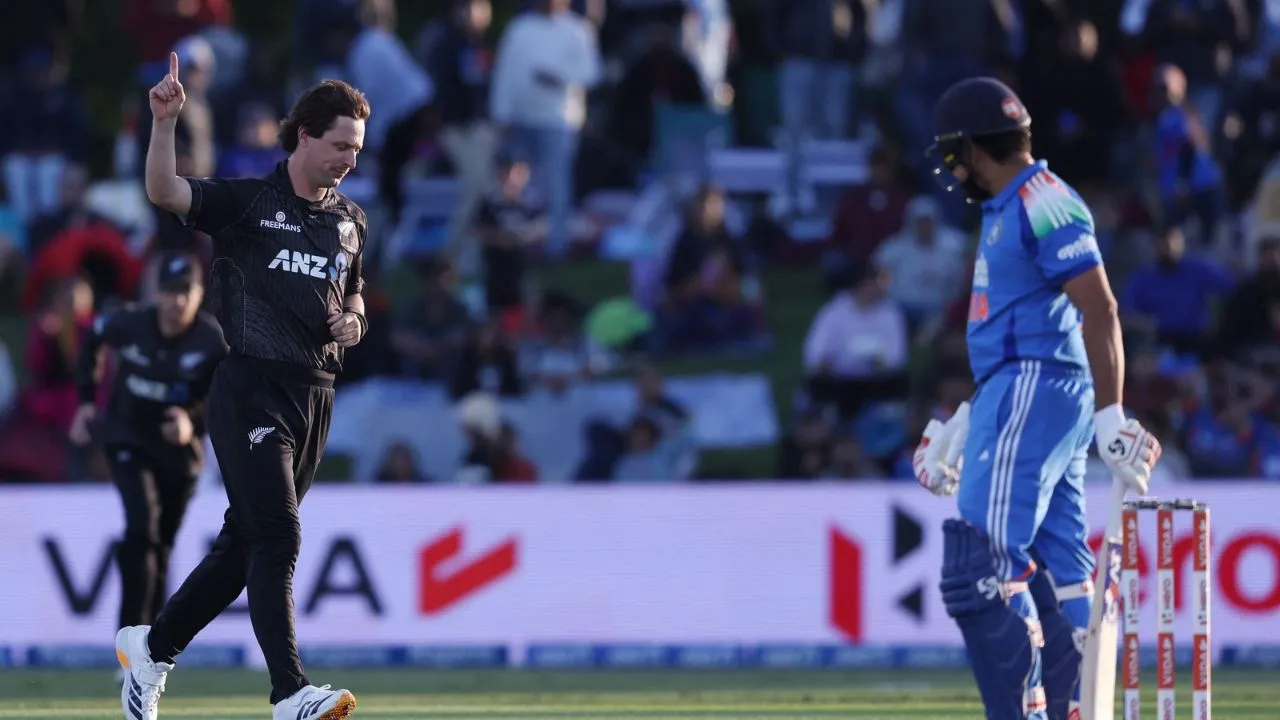
India’s chase of 334 in the fourth ODI against New Zealand began with a collapse so dramatic it immediately shifted the match’s momentum. Fast bowler Matt Henry claimed three wickets in the opening over, leaving the hosts reeling at 0 for 3 and putting New Zealand firmly in control of a contest that had promised to be a high-scoring affair.
Henry removed Rohit Sharma, Virat Kohli and Shreyas Iyer without conceding a run. The extraordinary opening spell gave India a mountain to climb and added a historic dimension to the match: it was only the third time in men’s ODI cricket that a team had lost three wickets in the first over. Pakistan had suffered the same fate against South Africa in 1997, while Bangladesh experienced it against Sri Lanka in 2003.
Henry’s remarkable return delivers an immediate impact
Henry’s performance was particularly striking given the setbacks he had faced before returning to New Zealand’s XI. He had missed the previous two ODIs while recovering from a minor tear in his right quadriceps. He also sustained a concussion during a training-ground collision with teammate Devon Conway at Eden Park. Yet, once the new ball was in his hands, the experienced seamer looked sharp and composed.
His first delivery to Rohit set the tone. Henry found extra bounce and movement away from the former India captain, who edged the challenge of the new ball and departed for a golden duck—the first time in his career he had been dismissed without scoring in that fashion. The wicket gave New Zealand an early breakthrough, but Henry was only getting started.
Kohli came in next and faced a delivery that moved back towards him and stayed low. The ball beat the batter and struck the stumps, sending one of India’s most dependable ODI run-scorers back to the pavilion for a duck. Henry then trapped Iyer in front. The on-field decision was not out, but New Zealand reviewed the call, and the technology confirmed the ball would have hit the stumps. Iyer was dismissed without scoring, completing a stunning three-wicket maiden.
India’s top order faces a historic test
The early damage was not limited to the first three wickets. India also became only the second side to lose its first four wickets for fewer than 10 runs in an ODI. The previous instance remains one of the sport’s most famous recovery stories: India were 9 for 4 against Zimbabwe at Tunbridge Wells during the 1983 World Cup before Kapil Dev produced an unforgettable 175 not out.
That comparison offers a reminder that a disastrous start does not always decide a match. However, India’s task was especially demanding, with a large target to chase and three senior batters already gone before the innings had properly begun. The pressure shifted to the remaining middle order to rebuild carefully while also finding a way to keep the required run rate within reach.
Rohit and Kohli being dismissed for ducks in the same ODI was not unprecedented. It had happened previously in Dambulla in 2010. The repeat underlined the unpredictability of limited-overs cricket: even two of India’s most accomplished batters can be undone quickly when conditions, movement and a bowler’s execution align.
Will Young anchors New Zealand’s imposing total
New Zealand had created the opportunity to attack by putting a substantial total on the board. Asked to bat first, the visitors finished on 333, powered by a superb innings from Will Young. His 125 provided the foundation for the total, while useful half-centuries from other New Zealand batters ensured the innings did not depend on one player alone.
Young’s contribution was important not only for its size but also for its timing. On a surface where New Zealand’s bowlers later found enough movement and bounce to trouble India, his ability to build an innings and convert it into a major score gave the visitors a strong platform. The total of 333 placed pressure on India from the start of the chase—and Henry’s opening over amplified it dramatically.
India’s bowlers did manage to take wickets during New Zealand’s innings. Axar Patel, Gurnoor Brar and Auqib Nabi each claimed two, helping prevent the visitors from pushing their score even higher. Kuldeep Yadav, returning to the side, went wicketless, but New Zealand’s batting depth and Young’s century still carried them to a challenging total.
Series stakes add pressure to the fourth ODI
The match also carries significant consequences for the series. India entered the contest leading 2–0 after winning the first two games, while the third ODI was abandoned without a result. With the series still in progress, a further Indian victory would secure the outcome for the hosts. New Zealand, meanwhile, need to win the remaining matches to draw level.
India’s squad has also been affected by changes, with Shubman Gill and KL Rahul leaving to join the Test squad. Their absence has added responsibility to the players available for the ODI, particularly with India’s top order facing an immediate crisis. In a chase of this scale, the balance between rebuilding and attacking becomes crucial: batters must steady the innings, but they cannot allow the required rate to climb unchecked.
Match prediction: New Zealand seize the advantage
Any match prediction following Henry’s opening over has to account for the size of India’s challenge. Chasing 334 after falling to 0 for 3 leaves little room for error, and New Zealand’s bowlers have the advantage of attacking a vulnerable middle order with a sizeable total behind them. Henry’s movement with the new ball also suggests that the conditions may continue to reward disciplined seam bowling.
India’s hopes depend on a substantial partnership from the batters still at the crease and a measured response to the early collapse. A counterattacking innings could change the complexion of the chase, particularly if India can rebuild without losing further wickets. But with three leading batters dismissed in the first over, New Zealand are clearly in the stronger position.
Henry’s spell will be remembered as one of the most astonishing starts to an ODI innings. His comeback from injury and concussion could hardly have been more emphatic, while Young’s century had already given New Zealand the platform to challenge India. The match now hinges on whether India can produce a recovery worthy of its most famous ODI comebacks—or whether New Zealand’s bowlers can turn a historic opening into a decisive victory.
Latest News

SA vs BAN Playing 11 Today, Live Streaming, Pitch & Weather: South Africa tour of Bangladesh 2026, 2nd Test

AUS vs ENG Playing 11 Today, Live Streaming, Pitch & Weather: England tour of Australia 2026, 2nd T20I

Blair Tickner ruled out of 2nd Test vs India, replacement named

Tim Paine and Justin Langer face fresh questions over Australia’s ball-tampering scandal

India tour of Bangladesh gets fresh hope as BCB confirms talks with BCCI

Tom Latham opens up on soft ball problem and saliva ban after draw against India

Ajinkya Rahane slams Tilak Varma for publicly criticising Shahbaz Ahmed after India A’s defeat

ICC to introduce IPL-style bat checks in international cricket

“Smiling Laughing doesn’t happen”: R Ashwin’s dig at India’s approach after draw vs New Zealand

“Not good enough for Test cricket”: Scott Styris, Sunil Gavaskar slam Wellington pitch

Dodda Ganesh declares India ‘out of WTC final race’ after Wellington Test draw

Ajinkya Rahane criticises Shubman Gill for abusing Akash Deep in 1st Test vs New Zealand

‘Why so many boundary riders?’ Dinesh Karthik questions Shubman Gill’s captaincy after Wellington Test

“I just want to enjoy my life”: Yash Dayal reflects on his return to cricket


