

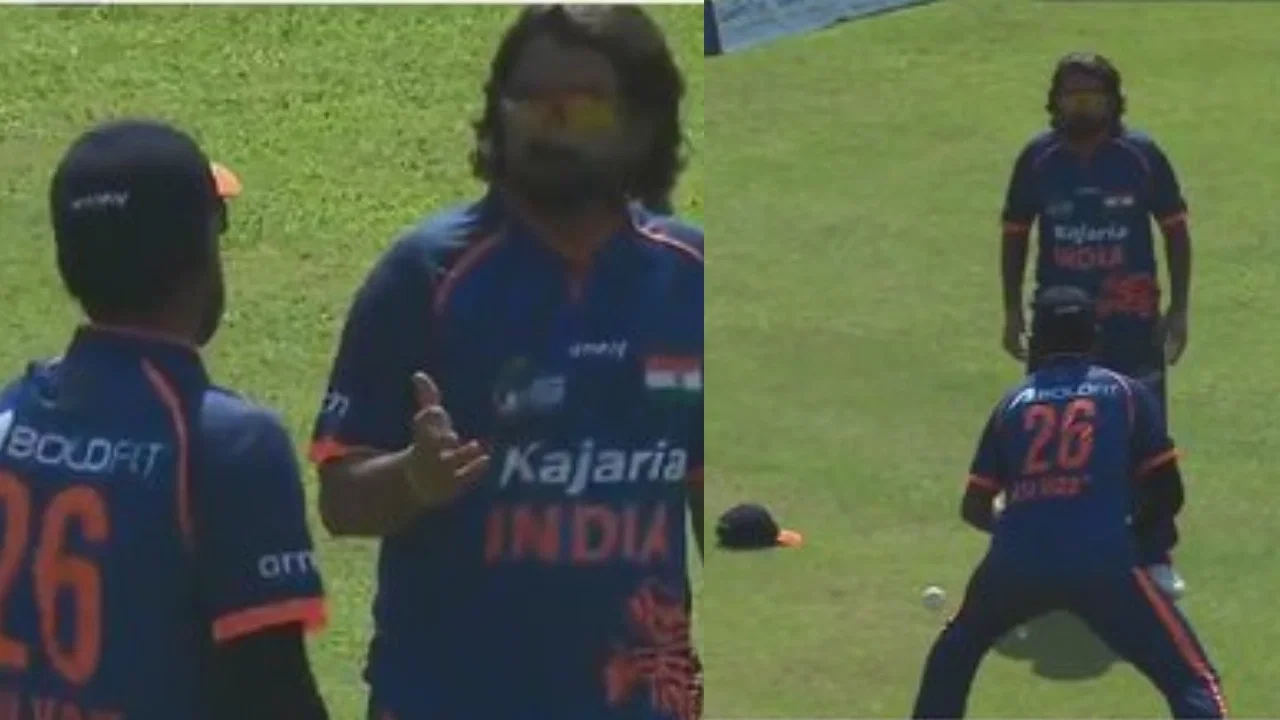
Rahul Tewatia and Kulwant Khejroliya recreate Saeed Ajmal and Shoaib Malik’s missed catch in Hong Kong Sixes
India’s Missed Catch and Late Collapse Hand England a Three-Run Hong Kong Sixes Win
India’s Hong Kong Sixes campaign took another frustrating turn on Saturday, as a missed opportunity in the field and a tense final over helped England secure a narrow three-run victory in the Bowl semi-final. Rahul Tripathi produced a spectacular unbeaten 56 from just 14 balls, but his extraordinary hitting could not quite carry India past England’s total at Mission Road Ground in Mong Kok.
The match’s most talked-about moment came when Rahul Tewatia and Kulwant Khejroliya converged on an aerial chance from Ed Barnard, then appeared to leave it for one another. The ball dropped safely between the two Indian fielders, giving Barnard a reprieve and prompting an awkward scene that quickly circulated among fans online. In a fast-paced six-a-side contest, where every delivery can change the prediction of the result, such a lapse can prove costly.
Awkward Fielding Moment Gives Barnard a Second Chance
Barnard lifted a delivery from Rahul Tripathi towards deep mid-wicket. Tewatia and Khejroliya both moved towards the ball, but neither committed to the catch. Their hesitation allowed it to land between them without a serious attempt, turning what looked like a promising chance into a missed opportunity.
Barnard made India pay. He finished unbeaten on 35 from 14 balls, striking four sixes and helping England maintain their momentum. The incident was especially conspicuous in a format built around explosive batting and rapid fielding decisions: with only six overs per innings, there is little time to recover from a missed chance or slow response.
Andersson Powers England to 124
England’s innings was led by Martin Andersson, who hammered 51 from only 13 deliveries before retiring out. His innings included three fours and six sixes, putting India’s bowlers under immediate pressure and giving England a strong platform. Luke Hollman added 13 from six balls, while Barnard’s late contribution helped the side finish on 124 for two from its allotted six overs.
Khejroliya endured a difficult spell, conceding 37 runs across two overs without taking a wicket. India did manage two breakthroughs, with Nitish Rana and Tripathi each claiming a wicket, but England’s aggressive approach kept the scoring rate high. The missed catch was one moment in a demanding fielding effort, yet it became a focal point because Barnard went on to add valuable runs.
Tripathi and Shashank Ignite India’s Chase
India’s pursuit of 125 began poorly. Nathan Gilchrist dismissed Rana for four in the opening over, and Jack Carson soon removed Tewatia for a two-ball duck. With two early wickets down, India needed a rapid response to stay within reach of England’s total.
Tripathi and Shashank Singh supplied it. The pair attacked England’s spin options, taking 30 runs from the single overs bowled by Hollman and Andersson. Shashank struck four sixes on his way to 29 from nine balls, giving India a burst of momentum at a crucial stage of the chase.
Tripathi went even further. He remained unbeaten on 56 from 14 balls, striking seven sixes and two fours at a remarkable strike rate of 400. His innings kept India’s hopes alive and made the finish far closer than England might have expected. But the early dismissals meant that the explosive partnership had little room for error, and India still needed a substantial final over.
Gilchrist Holds His Nerve in the Final Over
India required 18 runs from the last six deliveries, and England turned to Gilchrist to defend the target. He made an immediate impact by dismissing Shashank with the first ball, removing one of India’s main sources of momentum.
Krunal Pandya then struck two consecutive boundaries, reducing the equation to five runs from the final delivery. The pressure shifted sharply, and the outcome remained uncertain until the last ball. Gilchrist kept his composure, delivering a low full toss outside off stump. Pandya could only send the ball towards deep extra cover for a single, leaving India on 121 for four and England three runs ahead.
Gilchrist finished with figures of two for 25 and played a decisive role in the closing stages. His wicket of Shashank and controlled final delivery helped England protect a total that had looked vulnerable once Tripathi began his assault.
What the Result Means for Both Teams
The defeat was India’s third consecutive loss in the tournament, following group-stage setbacks against Pakistan and the UAE. Their performance against England showed the team’s capacity for explosive scoring, but also highlighted how early wickets and missed chances can shape a short-format match. Tripathi’s innings offered a striking individual highlight, while the final over underlined the value of execution under pressure.
England advanced to face South Africa in the Bowl final. India, meanwhile, are set to meet Bangladesh in the 11th-place playoff on Sunday, November 1. For both sides, the next match offers a chance to finish the competition on a stronger note.
For fans assessing the next fixture’s prediction, India’s batting firepower will be an important factor, particularly if Tripathi and Shashank can build another rapid partnership. However, the team will also need a more reliable start and sharper coordination in the field. In a tournament where matches are decided by tiny margins, converting chances and finishing the final over cleanly can matter just as much as hitting the biggest six.
Latest News

SA vs BAN Playing 11 Today, Live Streaming, Pitch & Weather: South Africa tour of Bangladesh 2026, 2nd Test

AUS vs ENG Playing 11 Today, Live Streaming, Pitch & Weather: England tour of Australia 2026, 2nd T20I

Blair Tickner ruled out of 2nd Test vs India, replacement named

Tim Paine and Justin Langer face fresh questions over Australia’s ball-tampering scandal

India tour of Bangladesh gets fresh hope as BCB confirms talks with BCCI

Tom Latham opens up on soft ball problem and saliva ban after draw against India

Ajinkya Rahane slams Tilak Varma for publicly criticising Shahbaz Ahmed after India A’s defeat

ICC to introduce IPL-style bat checks in international cricket

“Smiling Laughing doesn’t happen”: R Ashwin’s dig at India’s approach after draw vs New Zealand

“Not good enough for Test cricket”: Scott Styris, Sunil Gavaskar slam Wellington pitch

Dodda Ganesh declares India ‘out of WTC final race’ after Wellington Test draw

Ajinkya Rahane criticises Shubman Gill for abusing Akash Deep in 1st Test vs New Zealand

‘Why so many boundary riders?’ Dinesh Karthik questions Shubman Gill’s captaincy after Wellington Test

“I just want to enjoy my life”: Yash Dayal reflects on his return to cricket


