Ravichandran Ashwin slams Gautam Gambhir’s think tank over Kuldeep Yadav’s snub
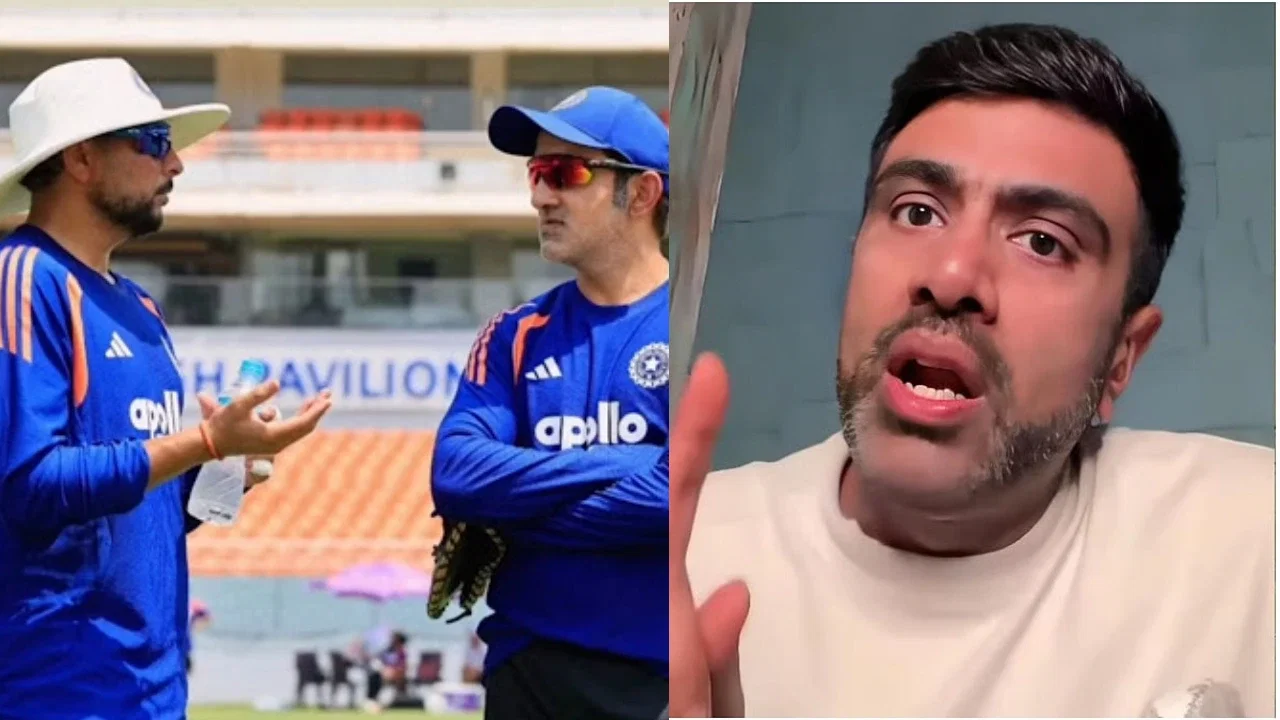
Ashwin Questions India’s Decision to Leave Kuldeep Yadav Out Against West Indies
Former India off-spinner Ravichandran Ashwin has questioned the team management’s decision to omit wrist-spinner Kuldeep Yadav from the fourth T20I against the West Indies, arguing that the left-armer could have offered a valuable option on a surface where the ball was expected to bounce.
India ultimately lost the Hyderabad match by 24 runs, allowing the West Indies to level the series at 2-2. The visitors powered their way to 247/3 before bowling India out for 223 in 19.3 overs. Shai Hope was the standout performer, striking an unbeaten 102 from just 50 deliveries in a commanding innings that shaped the result.
Speaking on his YouTube channel, Ashwin said Kuldeep’s variations could have challenged a West Indies batting line-up that had struggled to pick his googly and leg-spin. While Hyderabad is not traditionally regarded as a venue where spinners dominate, Ashwin suggested that the pitch conditions and the opposition’s record against Kuldeep made the selection call particularly surprising.
Why Ashwin believes Kuldeep could have mattered
Ashwin’s argument was not simply that India should always play an additional spinner. Instead, he focused on the match-up. Kuldeep has built a reputation for changing his pace, trajectory and angle, making it difficult for batters to read his deliveries early. Against a powerful batting side such as the West Indies, that uncertainty can be especially useful, even on a surface that does not offer substantial turn.
“It is very surprising because, on a ground where you expect to get some bounce, I know it has not always been a happy hunting ground for spinners, but the West Indies batters are struggling to pick his googly and leg-spin,” Ashwin said.
The former India international also suggested that Kuldeep’s presence might have helped restrict the West Indies by 15 to 20 runs. In a high-scoring T20 contest, that margin can be significant. A reduced target could have changed India’s approach during the chase, eased the pressure on the middle order and made the final overs more manageable.
Ashwin was pointed in his assessment of the selection decision, saying that leaving Kuldeep out against this particular opposition lacked common sense. His comments underline the importance of using match-ups and player-specific records alongside broader considerations such as pitch conditions and team balance.
Kuldeep’s numbers against the West Indies
Kuldeep’s T20I record against the Caribbean side supports Ashwin’s case. The spinner has taken 20 wickets in 11 matches against the West Indies, averaging 15.70 runs per wicket and conceding at an economy rate of 7.13 runs per over.
Those figures suggest that Kuldeep has repeatedly found ways to trouble West Indies batters. His ability to disguise the googly and attack the stumps can make him a useful option in the middle overs, when teams often look to build momentum before accelerating at the death. Even when he does not take wickets, a bowler who forces batters to hesitate or alter their shots can help control the scoring rate.
That does not mean his selection would automatically have changed the outcome in Hyderabad. The West Indies’ total was built on aggressive, effective batting, and India’s bowling unit faced a demanding task throughout the innings. Still, Ashwin’s point is that Kuldeep offered a specific tactical advantage that the team may have chosen not to use.
Ashwin distinguishes between Hyderabad and Indore
Ashwin’s criticism was not a blanket demand for Kuldeep to feature in every match. He said he could understand the decision to leave the spinner out in Indore, where the smaller boundaries can make it difficult for bowlers to contain batters. That distinction is important: selection decisions depend on the venue, conditions and likely match-ups, not just a player’s reputation.
He also rejected the suggestion that Kuldeep should be blamed for India’s earlier defeat in Ranchi. In that second T20I, Kuldeep took one wicket for 53 runs as India failed to defend a total of 249. Ashwin argued that judging the spinner solely by those figures—and linking them directly to the loss—would be unfair.
“I was surprised. Kuldeep was not picked in Indore, and I would still endorse that decision because I can understand that the ground is small. But you are almost making an issue out of it by suggesting that India’s loss in Ranchi was because of Kuldeep. That, in itself, is wrong,” Ashwin said.
Selection debate adds another layer to the series
The discussion highlights a familiar challenge for T20 teams: balancing specialist skills with the need for batting depth and flexibility. A spinner’s value cannot always be measured through wickets alone. Captains and coaches must also consider whether a particular bowler can exploit an opponent’s weakness, defend one side of the ground or disrupt a partnership before it gathers speed.
In Hyderabad, the West Indies’ total of 247 put India under immediate pressure. Hope’s unbeaten century gave the visitors a platform, while the rest of the batting effort helped maintain a scoring rate that left India with little room for error. India’s reply reached 223, but the target proved too steep, and the 24-run defeat meant the series was level heading into the decider.
Ashwin’s comments have therefore turned the team’s selection into a key talking point ahead of the final match. Whether Kuldeep returns to the playing XI will depend on the conditions and India’s preferred combination, but his record against the West Indies makes him a compelling option. The prediction around the selection debate is likely to remain unsettled until the teams are announced: the management must weigh the risk of a high-scoring venue against the potential reward of deploying a bowler the opposition has historically found difficult to read.
For Ashwin, the central issue is not that Kuldeep should be immune from criticism or selected regardless of circumstances. It is that India should make a clear distinction between a venue-based decision and a match-up-based one—and avoid blaming a single player for a team defeat. Against the West Indies, he believes Kuldeep’s variations could have been worth backing.
Latest News
Mitchell Starc may skip IPL 2027 to prioritise Australia’s Test commitments
Yuvraj Singh reveals how Sourav Ganguly offered him Delhi Capitals coaching job
Pathum Nissanka ruled out of Pakistan ODI tri-series, Lahiru Udara named replacement

Sunil Gavaskar furious with Shamar Joseph after Arshdeep Singh incident
“MS Dhoni made our job 50% easier”: Yuzvendra Chahal reveals captain cool’s big contribution
Ravichandran Ashwin slams Gautam Gambhir’s think tank over Kuldeep Yadav’s snub
Ravichandran Ashwin wants Rohit Sharma back as MI captain, gives big advice on Hardik Pandya

Faf du Plessis puts Cricket South Africa administration under scrutiny after Durban Test loss vs AUS
Abhishek Sharma breaks Suryakumar Yadav’s record with 69 sixes in 2026

“Not in the spirit of the game” – Shreevats Goswami slams Shamar Joseph’s bowling against Arshdeep Singh

Smriti Mandhana targets historic T20I record in first series as India captain
Sunil Gavaskar defends India’s flat pitches, blames bowlers instead

Cameron Green injury update: All-rounder doubtful for 2nd Test vs South Africa
Nic Maddinson responds to criticism from Australia legends over Test recall