

Tilak Varma suffers bizarre double dismissal in same over against Nathan Smith in 5th T20I
India vs New Zealand 5th T20I: Iyer and Kishan Lead Fightback as Tilak Varma Falls for Six
India and New Zealand met at Seddon Park in Hamilton for the fifth and final T20I, with the series already decided in the visitors’ favour. India had secured the trophy by winning the first three matches, but arrived at the finale looking to respond after a heavy defeat in the fourth game and finish the tour’s T20 leg on a positive note.
The match also offered a final opportunity for both sides to sharpen their plans ahead of the upcoming ODI series. India made a competitive start after being asked to bat, thanks largely to a rapid partnership between Ishan Kishan and captain Shreyas Iyer. But a cluster of wickets in the middle overs slowed the scoring, leaving the visitors with work to do against a New Zealand attack led by Adam Milne.
Tilak Varma’s unusual dismissal after a no-ball reprieve
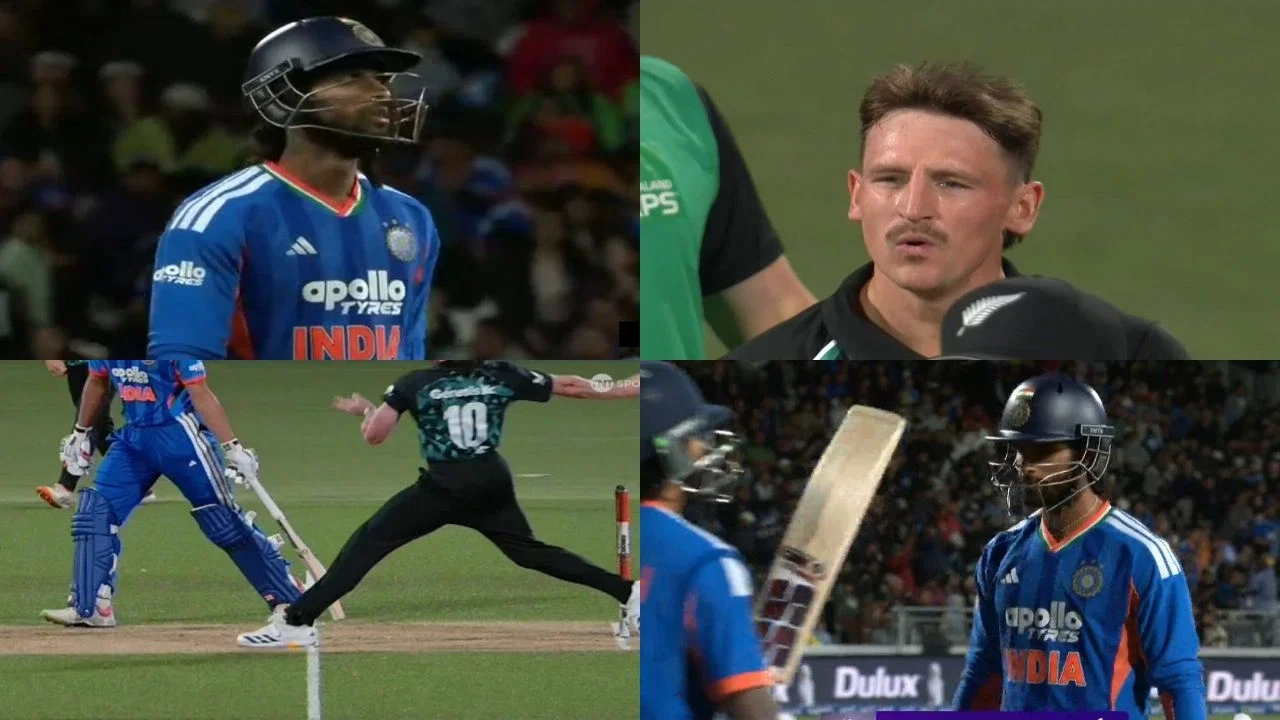
One of the innings’ most dramatic moments involved Tilak Varma, who appeared to be dismissed twice in the same over. In the 14th over, the left-hander attempted to work a delivery from Nathan Smith towards the leg side. He closed the face of his bat too early, sending a thick leading edge into the air.
Finn Allen reacted sharply, moving to his right to complete an impressive catch. However, the celebrations were cut short when the delivery was called a no-ball, giving Varma a reprieve. The catch was a moment of fielding brilliance, but the extra delivery meant the batter remained at the crease.
Varma could not make the most of the second chance. Two balls later, he tried to pull a short delivery from Smith, but the ball climbed more than expected and hurried onto him. The mistimed shot went back towards the bowler, who took a straightforward return catch. Varma departed for six from eight balls, ending a brief and frustrating stay at the crease.
The sequence highlighted how quickly momentum can shift in T20 cricket. Allen’s catch briefly threatened to remove a key batter, while the no-ball offered India a reprieve. Smith, however, stayed composed and struck again almost immediately. For Varma, the episode was a reminder that a second chance only matters if it can be turned into runs.
Kishan and Iyer rebuild after early setbacks
New Zealand won the toss and chose to field, putting India under early pressure. The hosts made an immediate impact by dismissing openers Abhishek Sharma and Sanju Samson before either could settle. With two recognised batters gone, India needed a partnership to restore control of the innings.
Kishan and Iyer provided exactly that. The pair attacked the New Zealand bowlers with intent, combining for a 93-run stand from just 43 deliveries. Their approach helped India recover from the early losses and brought the scoring rate back up, with both batters finding boundaries regularly rather than allowing the fielding side to dictate the tempo.
Kishan was particularly influential, striking 61 from 32 balls. His innings included five fours and five sixes, giving India the acceleration it needed during the middle phase. The left-hander’s clean hitting and willingness to take on the bowlers made him the innings’ leading run-scorer and reinforced his strong form during 2026.
Iyer matched the urgency at the other end. The captain reached his half-century from only 23 balls, hitting four sixes and three fours. His innings gave India a second source of momentum and helped ensure the partnership was not built solely around Kishan’s aggression. Together, the pair turned a difficult start into a promising platform.
Middle-order slowdown limits India’s total
Once Kishan and Iyer were dismissed, India struggled to maintain the same scoring pace. Varma’s short innings added little, while Naman Dhir contributed a useful 33 from 23 balls. Nitish Kumar Reddy chipped in with 22, but the middle and lower order could not produce another substantial stand to carry India towards a much larger total.
Bhuvneshwar Kumar added valuable late runs, helping India reach 191. The total was competitive, particularly after the early wickets, but the late slowdown left the innings short of the momentum created by Kishan and Iyer. On a ground where boundaries can come quickly, India’s bowlers were likely to need early breakthroughs and disciplined execution to protect the score.
Milne leads New Zealand’s bowling effort
Adam Milne was New Zealand’s standout bowler, finishing with four wickets for 19 runs from his four overs. His figures were a major factor in preventing India from turning its strong partnership into an even bigger total. Blair Tickner and Nathan Smith also claimed two wickets apiece, with Smith responsible for Varma’s dismissal after the no-ball reprieve.
New Zealand’s bowling performance showed the value of taking wickets at key moments. The hosts were punished during the Kishan-Iyer partnership, but their ability to break it and then restrict India’s middle order helped bring the innings back under control. Milne’s economy and wicket-taking threat were especially important on a surface where batters could score quickly.
India vs New Zealand 5th T20I: Match outlook and prediction
At 191, India had a total that could challenge New Zealand, but the contest remained open. Seddon Park’s relatively compact boundaries can make even a substantial target feel attainable, especially if the home side’s top order gets off to a fast start. India’s best route to defending the score was likely to be early wickets, tight lines and careful use of its bowling options.
New Zealand, meanwhile, had the advantage of knowing the conditions and had already shown that it could take wickets in clusters. The match prediction depended heavily on the opening overs of the chase: a strong start from the hosts could put pressure on India’s bowlers, while early breakthroughs would bring the visitors firmly back into the contest.
Regardless of the final result, India had already achieved its main objective by winning the T20I series. The team’s first away T20I series victory in a SENA nation under Iyer added significance to the campaign. After the fifth match, attention would shift to the ODI series, with both teams carrying lessons from the final T20I: India’s top-order firepower was clear, but converting promising starts into a larger total remained a key area to address.
Latest News

SA vs BAN Playing 11 Today, Live Streaming, Pitch & Weather: South Africa tour of Bangladesh 2026, 2nd Test

AUS vs ENG Playing 11 Today, Live Streaming, Pitch & Weather: England tour of Australia 2026, 2nd T20I

Blair Tickner ruled out of 2nd Test vs India, replacement named

Tim Paine and Justin Langer face fresh questions over Australia’s ball-tampering scandal

India tour of Bangladesh gets fresh hope as BCB confirms talks with BCCI

Tom Latham opens up on soft ball problem and saliva ban after draw against India

Ajinkya Rahane slams Tilak Varma for publicly criticising Shahbaz Ahmed after India A’s defeat

ICC to introduce IPL-style bat checks in international cricket

“Smiling Laughing doesn’t happen”: R Ashwin’s dig at India’s approach after draw vs New Zealand

“Not good enough for Test cricket”: Scott Styris, Sunil Gavaskar slam Wellington pitch

Dodda Ganesh declares India ‘out of WTC final race’ after Wellington Test draw

Ajinkya Rahane criticises Shubman Gill for abusing Akash Deep in 1st Test vs New Zealand

‘Why so many boundary riders?’ Dinesh Karthik questions Shubman Gill’s captaincy after Wellington Test

“I just want to enjoy my life”: Yash Dayal reflects on his return to cricket


