

Top 3 worst trades in IPL history: CSK, LSG among biggest culprits
Three IPL Trades That Could Prove Costly for the Teams Involved
Player trades have become an increasingly important part of the Indian Premier League, giving franchises another way to reshape their squads before the auction. A well-planned swap can fill a glaring weakness without relying on the bidding process. But trades also carry risk: a player who thrives in one team’s system may struggle in another, while the club giving him up may later regret losing his particular skills.
Several high-profile deals have prompted questions about whether the teams involved received equal value. The Shahbaz Ahmed–Mayank Dagar swap, the Avesh Khan–Devdutt Padikkal exchange, and the reported four-player arrangement between Chennai Super Kings and Sunrisers Hyderabad all illustrate how quickly a trade can look different once the season begins. Here’s a closer look at the deals, their consequences, and what each one may mean for the teams’ future plans.
1. Shahbaz Ahmed–Mayank Dagar Swap: RCB and SRH, 2024
Royal Challengers Bengaluru and Sunrisers Hyderabad completed a direct exchange ahead of IPL 2024, with Shahbaz Ahmed moving to SRH and left-arm spinner Mayank Dagar joining RCB. The move followed a difficult 2023 campaign for Shahbaz, who scored 42 runs and claimed one wicket in 10 matches. RCB appeared to be seeking a change in their spin options, while SRH saw potential value in an all-rounder capable of contributing with both bat and ball.
In hindsight, the trade worked far better for Sunrisers. Shahbaz became a useful squad option during SRH’s run to the 2024 final, offering lower-order batting and providing a left-arm spin option when required. His value was not limited to headline statistics: in a long tournament, a player who can cover multiple roles gives a team more flexibility with its combinations.
Dagar, meanwhile, found it difficult to make a consistent impact for RCB. The conditions at Bengaluru’s M. Chinnaswamy Stadium can be unforgiving for spinners, particularly when batters are able to attack from the outset. Dagar’s economy rate rose above 10, and he did not establish himself as the dependable bowling option RCB had hoped to acquire.
Trade verdict: SRH appeared to gain the more effective contributor. The deal also highlights a key lesson for franchises: judging a player solely on one season’s numbers can be risky. Role, venue, team balance and confidence all influence performance, and Shahbaz’s broader skill set proved valuable in his new environment.
2. Avesh Khan–Devdutt Padikkal Swap: LSG and RR, 2024
Lucknow Super Giants and Rajasthan Royals exchanged fast bowler Avesh Khan and top-order batter Devdutt Padikkal before IPL 2024. LSG brought in Padikkal to add depth to their batting, while RR targeted Avesh to strengthen their pace attack, particularly in the closing overs.
Rajasthan’s investment paid off more clearly. Avesh handled high-pressure situations and added another pace option alongside Trent Boult and Sandeep Sharma. His ability to bowl at different stages of an innings gave RR greater tactical flexibility, especially when the team needed to defend a total or disrupt a batting side’s momentum.
Padikkal’s move to LSG, by contrast, did not produce the expected returns. He played seven matches and scored 38 runs, struggling to secure a settled place and make an impact in the top order. That outcome was particularly disappointing for LSG because the trade cost them a proven fast bowler who could address a specific bowling need.
Of course, a player’s short-term results do not tell the whole story. Batting order, confidence and opportunities can all affect a batter’s output, while a fast bowler’s effectiveness depends on workload, fitness and match conditions. Still, based on their contributions during the season, Avesh gave RR more immediate value than Padikkal delivered for LSG.
Trade verdict: Rajasthan appeared to win the exchange in the short term. For LSG, the deal underlined the importance of evaluating not only a player’s reputation but also where he is likely to bat and how many chances he will receive.
3. The Four-Player CSK–SRH Trade: A High-Stakes IPL 2027 Prediction
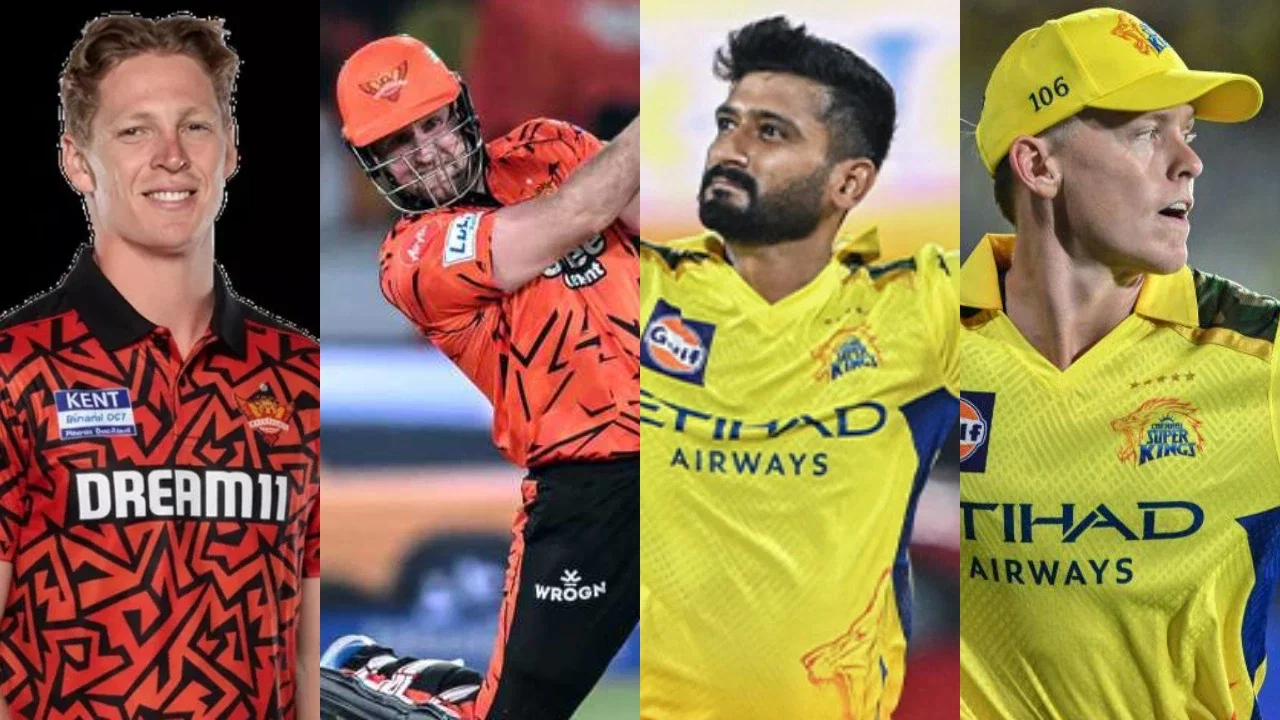
A reported four-player trade between Chennai Super Kings and Sunrisers Hyderabad has drawn attention ahead of IPL 2027. The deal, completed on November 5, sends Liam Livingstone and Jack Edwards to CSK, while Khaleel Ahmed and Nathan Ellis move to SRH. The exchange is a significant squad-building decision because it changes the balance of both teams rather than simply replacing one player with another.
Livingstone has reportedly joined CSK for INR 6 crore, down from his previous contract value of INR 13 crore. Edwards is set to move at his existing fee of INR 3 crore. SRH, meanwhile, receive Khaleel for INR 4.8 crore and Ellis for INR 2 crore ahead of the mini-auction in Goa.
At first glance, the deal gives CSK two players who can broaden their options. Livingstone is known for his power hitting and can offer a part-time bowling option, while Edwards could add further all-round depth. In a tournament where teams must adapt to different pitches and match situations, that versatility can be useful.
However, the trade also asks CSK to give up two specialist fast bowlers. Khaleel was among the team’s notable performers in 2025, taking 15 wickets in 14 matches. Injuries affected his 2026 campaign, but his previous output shows the potential value CSK are relinquishing. Ellis brings experience and skills suited to death bowling, a phase in which even a few accurate overs can shape a match.
The central question is whether Livingstone and Edwards can make a large enough contribution to offset the loss of that pace-bowling depth. Edwards has yet to make his IPL debut, so his adaptation to the competition remains uncertain. Livingstone, meanwhile, will need to deliver consistently rather than rely on occasional explosive innings. CSK may also have to use the auction to rebuild their fast-bowling resources.
For SRH, the incoming pair could strengthen a pace unit with options for different stages of an innings. If Khaleel returns to full fitness and Ellis performs his death-over role reliably, the trade could address a clear squad need. The outcome will ultimately depend on availability, form and how each franchise uses its new players.
Early prediction: SRH may have secured the more dependable immediate bowling value, while CSK have chosen a higher-upside path by investing in all-round options. That assessment could change if Livingstone produces a strong season or Edwards quickly adapts to IPL cricket. Until then, the deal looks like a calculated gamble rather than a guaranteed upgrade.
What These IPL Trades Reveal
These three exchanges show why a trade’s success cannot be judged by the names involved alone. Teams must consider role clarity, venue conditions, fitness, workload and the opportunities a player is likely to receive. A versatile all-rounder can improve squad flexibility, but that benefit may not outweigh the loss of a specialist who fills a difficult role.
For supporters following every IPL prediction and squad update, the next season will provide the real test. Shahbaz and Avesh demonstrated how players can flourish after a change of team, while the CSK–SRH deal will be judged by whether its new arrivals deliver more than the bowlers who departed. In a competition where small changes can influence playoff chances, these trades could have consequences well beyond the auction table.
Latest News

SA vs BAN Playing 11 Today, Live Streaming, Pitch & Weather: South Africa tour of Bangladesh 2026, 2nd Test

AUS vs ENG Playing 11 Today, Live Streaming, Pitch & Weather: England tour of Australia 2026, 2nd T20I

Blair Tickner ruled out of 2nd Test vs India, replacement named

Tim Paine and Justin Langer face fresh questions over Australia’s ball-tampering scandal

India tour of Bangladesh gets fresh hope as BCB confirms talks with BCCI

Tom Latham opens up on soft ball problem and saliva ban after draw against India

Ajinkya Rahane slams Tilak Varma for publicly criticising Shahbaz Ahmed after India A’s defeat

ICC to introduce IPL-style bat checks in international cricket

“Smiling Laughing doesn’t happen”: R Ashwin’s dig at India’s approach after draw vs New Zealand

“Not good enough for Test cricket”: Scott Styris, Sunil Gavaskar slam Wellington pitch

Dodda Ganesh declares India ‘out of WTC final race’ after Wellington Test draw

Ajinkya Rahane criticises Shubman Gill for abusing Akash Deep in 1st Test vs New Zealand

‘Why so many boundary riders?’ Dinesh Karthik questions Shubman Gill’s captaincy after Wellington Test

“I just want to enjoy my life”: Yash Dayal reflects on his return to cricket


