

Watch: Daryl Mitchell’s monstrous six off Arshdeep Singh nearly crushes security guard’s head
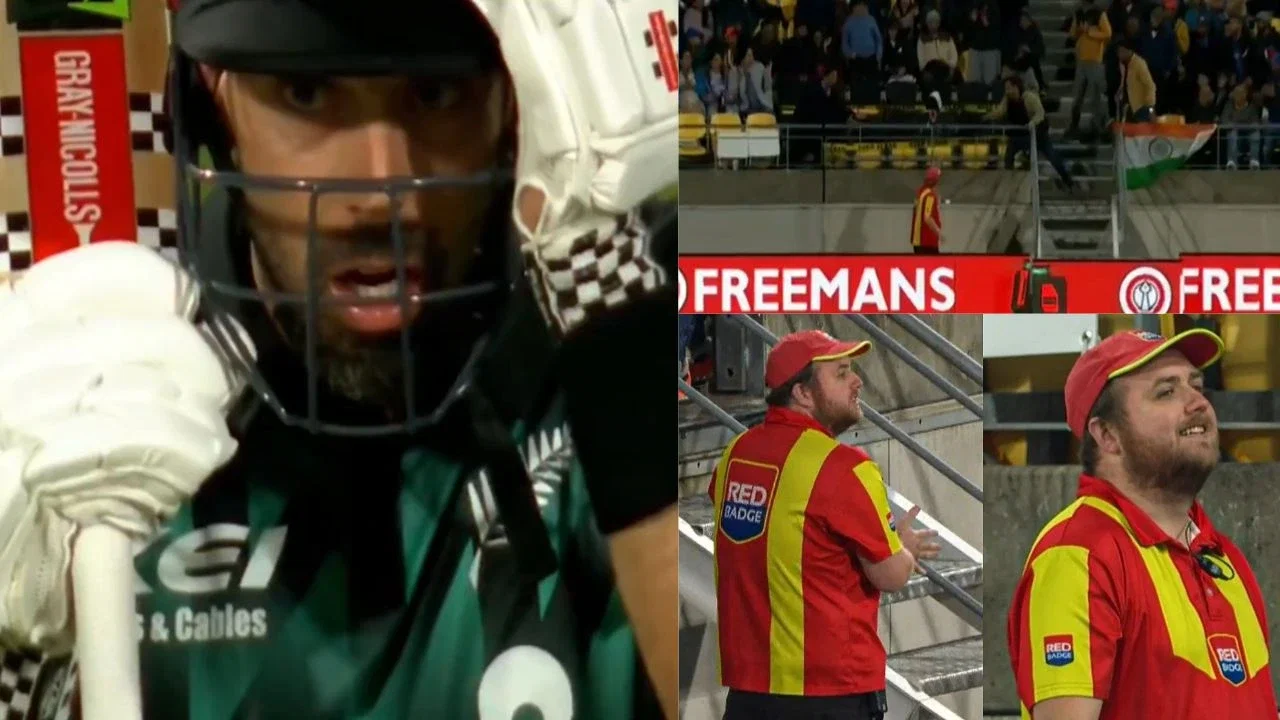
Daryl Mitchell’s Powerful Six Nearly Hits Security Guard in New Zealand vs India T20I
A fierce pull shot from Daryl Mitchell produced one of the most startling moments of the third T20I between New Zealand and India at Wellington’s Sky Stadium on October 27, 2026. The New Zealand batter launched a short ball from Arshdeep Singh towards the boundary, where it passed dangerously close to a security guard who appeared to be looking towards the stands.
The incident briefly shifted attention from the contest to the safety of those working around the playing area. Mitchell’s shot had travelled at considerable speed, leaving the steward little time to react. Replays showed just how narrowly the ball missed him, while Mitchell watched its path with visible concern.
Mitchell’s pull shot creates a frightening moment
The near miss occurred on the first delivery of the sixth over of New Zealand’s innings. Arshdeep bowled a short ball, and Mitchell quickly got into position, pulling it hard and flat towards the boundary. It was a cleanly struck shot, but its trajectory took it close to the guard stationed near the edge of the field.
The steward did not appear to see the ball coming, as his attention was directed towards the crowd. For a moment, the shot seemed to be heading directly towards him. Mitchell tracked the ball after making contact and appeared uneasy as it passed close by. The replay underlined the danger of a fast-moving cricket ball travelling into areas where staff and spectators may not be watching the play.
There was no indication in the account of the incident that the guard was struck. Still, the episode served as a reminder that boundary areas can be hazardous, particularly when batters target the shorter sides of a ground or hit powerful shots along a low trajectory. Stadium stewards, photographers and other event staff often work close to the field, making clear sightlines and awareness of the game essential.
Mitchell makes an impact with the bat
Mitchell’s six was part of an aggressive contribution in the middle order. At the time the report was filed, he was batting on 48 from 25 deliveries, with four fours and three sixes. His scoring rate helped New Zealand maintain momentum as the hosts looked to build a competitive total against India.
The innings also highlighted Mitchell’s value in the T20 format. He can respond quickly to a change of pace, use his strength to clear the boundary and keep the scoreboard moving when a team needs to accelerate. His ability to attack short deliveries made Arshdeep’s ball an opportunity, although the resulting shot came uncomfortably close to someone beyond the boundary rope.
For viewers following the match, the moment was both a striking display of power and a reminder that a six is not simply a scoring event. In modern T20 cricket, the ball can travel into crowded or restricted areas in an instant. Ground staff and security teams must remain alert even when attention is naturally drawn towards the spectators.
New Zealand make three changes for the third T20I
New Zealand captain Mitchell Santner confirmed three changes to his side for the Wellington match. Matt Henry, Lockie Ferguson and Nathan Smith were unavailable, with the bowling group adjusted through a combination of rotation and player availability. Matt Fisher returned, while Kyle Jamieson and Adam Milne also came into the lineup.
Santner said the surface appeared to offer pace and bounce, and he indicated that New Zealand would bowl first. He also noted that Wellington’s conditions and ground dimensions differed from those at the earlier venues, meaning both teams would need to adjust their plans. In a T20 match, those details can influence decisions about bowling lengths, boundary protection and how batters approach the powerplay.
The captain also reflected on New Zealand’s performances in the first two matches. He said his side had put itself in strong positions but had allowed India back into the contests. Santner acknowledged that India were a difficult team to contain once they regained momentum, making the third match an important opportunity for New Zealand to execute more consistently.
What the Wellington conditions could mean
A pitch offering pace and bounce can create opportunities for fast bowlers, especially early in an innings. Short deliveries may be effective when used carefully, but they also provide powerful batters with chances to pull or hook. Mitchell’s six illustrated that risk: a delivery intended to challenge the batter can quickly become a scoring opportunity if the batter reads the length early.
Wellington’s boundary dimensions may also shape the tactical contest. Captains and bowlers often need to identify which side of the ground is shorter and adjust their fields accordingly. For batters, that can create clear targets; for bowlers, it makes control of line and length especially important. These factors add context to a match in which New Zealand were seeking to make the most of home conditions while India looked to maintain pressure.
Prediction: a key test of execution for both sides
Any prediction for a T20 match depends on more than the names in the playing XI. The pitch, boundary sizes, early wickets and the handling of pressure can all change the balance quickly. New Zealand’s revised bowling group offered fresh options, while India’s ability to recover from difficult situations had already been a talking point in the series.
Mitchell’s attacking start gave the hosts a platform, but the wider challenge was to convert promising positions into a strong finish. Santner’s comments suggested that New Zealand understood the need to sustain pressure rather than give India an opening. The third T20I therefore carried significance beyond one dramatic six: it was a test of discipline, adaptability and decision-making in conditions that demanded quick adjustments.
The near miss at the boundary remained the most alarming image from Mitchell’s innings. It showcased the force behind his shot, but also highlighted the importance of safety around the field. As the match continued, the focus returned to the contest between bat and ball, with New Zealand aiming to build on their home advantage and India looking to respond in a closely watched T20 series.
Latest News

SA vs BAN Playing 11 Today, Live Streaming, Pitch & Weather: South Africa tour of Bangladesh 2026, 2nd Test

AUS vs ENG Playing 11 Today, Live Streaming, Pitch & Weather: England tour of Australia 2026, 2nd T20I

Blair Tickner ruled out of 2nd Test vs India, replacement named

Tim Paine and Justin Langer face fresh questions over Australia’s ball-tampering scandal

India tour of Bangladesh gets fresh hope as BCB confirms talks with BCCI

Tom Latham opens up on soft ball problem and saliva ban after draw against India

Ajinkya Rahane slams Tilak Varma for publicly criticising Shahbaz Ahmed after India A’s defeat

ICC to introduce IPL-style bat checks in international cricket

“Smiling Laughing doesn’t happen”: R Ashwin’s dig at India’s approach after draw vs New Zealand

“Not good enough for Test cricket”: Scott Styris, Sunil Gavaskar slam Wellington pitch

Dodda Ganesh declares India ‘out of WTC final race’ after Wellington Test draw

Ajinkya Rahane criticises Shubman Gill for abusing Akash Deep in 1st Test vs New Zealand

‘Why so many boundary riders?’ Dinesh Karthik questions Shubman Gill’s captaincy after Wellington Test

“I just want to enjoy my life”: Yash Dayal reflects on his return to cricket


