

Watch: Shubman Gill clashes with umpires after Glenn Phillips’ DRS confusion in 1st IND vs NZ Test
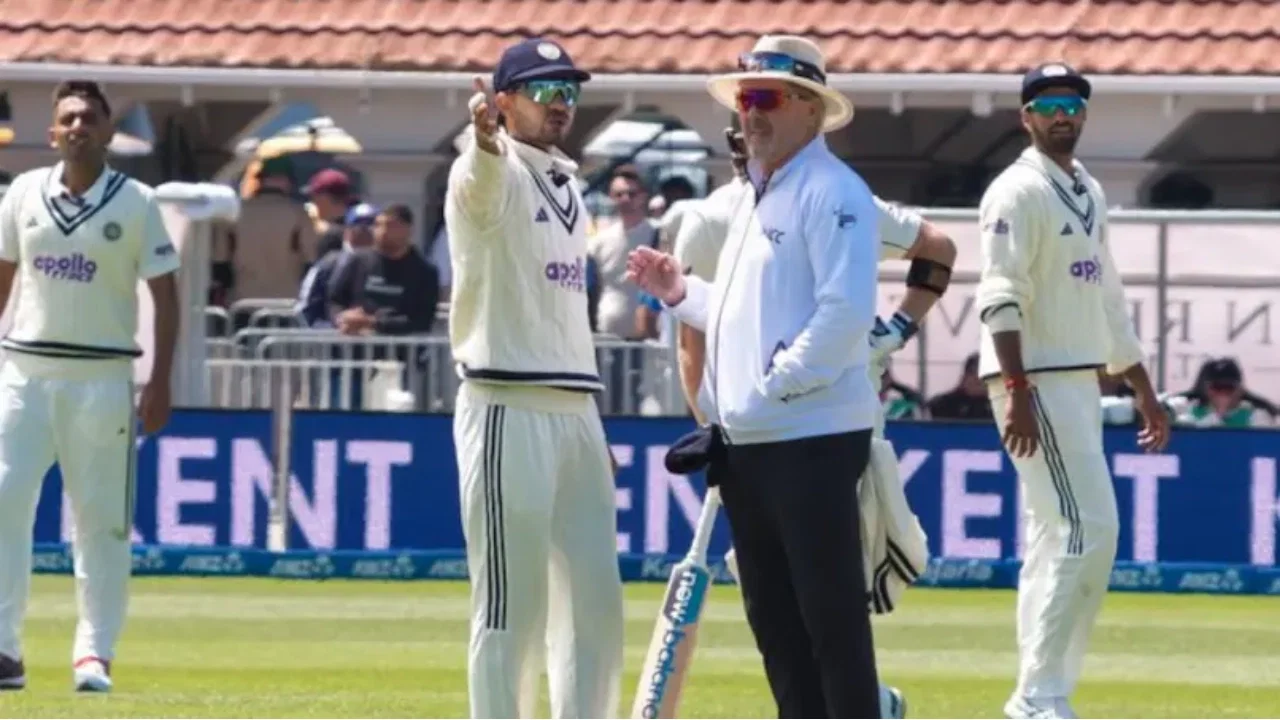
Shubman Gill Questions Glenn Phillips DRS Call as India’s Pacers Strike Early
India captain Shubman Gill was left visibly frustrated after a review against Glenn Phillips failed during the opening day of the first Test against New Zealand at Wellington’s Basin Reserve. The decision sparked a tense exchange between Gill and on-field umpire Richard Illingworth, after third umpire Paul Reiffel upheld the original not-out call.
The disputed moment came in the 31st over, with India looking to press their advantage after a strong start with the ball. Jasprit Bumrah beat Phillips with a delivery that jagged back sharply, prompting a confident appeal for leg before wicket. Illingworth turned it down, and Gill chose to review after a brief discussion with Bumrah and the wicketkeeper.
Why India’s review against Phillips was unsuccessful
The exchange between bowler and captain suggested they were weighing up different parts of the decision. Bumrah appeared concerned that the ball might be passing over the stumps, telling Gill, “height hai” — meaning it was too high. Gill, meanwhile, believed Phillips had not edged the delivery and responded, “bat nahi hai,” or “there’s no bat.”
Replays made the review difficult to assess. The Snickometer showed a noticeable spike as the ball passed near Phillips’ bat, but the available front-on footage did not clearly reveal an inside edge. After examining the images, Reiffel requested another slow-motion replay and concluded that the ball had made slight contact with the bat before striking the batter’s back pad.
With that finding, the third umpire upheld Illingworth’s original decision. Gill remained unconvinced and approached the on-field umpire, arguing that there appeared to be a gap between bat and pad and that the ball had hit the pad first. Illingworth explained the ruling, but the captain walked away shaking his head. Bumrah and several Indian players also appeared unhappy with the outcome.
The possible edge was not the only factor in the appeal. The delivery also seemed likely to pass over the stumps, which would have made the LBW review unsuccessful even if the ball had struck Phillips’ pad before his bat. The episode offered a reminder of how several technical elements—bat contact, impact and the ball’s projected path—can shape a single DRS decision.
India’s pace attack puts New Zealand under pressure
Although the review became one of the session’s most talked-about moments, India had already made an impressive start. Gill won the toss and elected to bowl, a decision that quickly paid off as the visitors’ fast bowlers found movement and troubled New Zealand’s top order.
Bumrah struck in the first over, dismissing New Zealand captain Tom Latham for a two-ball duck. Latham left a good-length delivery, but the ball moved back sharply and hit the top of off stump. The early breakthrough set the tone for a demanding morning for the hosts.
Bumrah added another wicket, while Akash Deep and Anshul Kamboj also claimed a scalp apiece. New Zealand reached lunch at 60 for four, having lost four wickets in the first session. The score reflected India’s disciplined approach: the bowlers maintained pressure, made the most of the conditions and forced the home batters to work hard for runs.
The Basin Reserve is known for offering assistance to seamers, particularly when the weather and surface provide movement through the air or off the pitch. In those conditions, accuracy can be as important as pace. India’s attack kept the ball in challenging areas, making it difficult for New Zealand’s batters to settle into a rhythm.
Rishabh Pant returns as India choose four specialist quicks
India’s team selection underlined their intention to make the most of the conditions. The visitors went with four specialist fast bowlers: Bumrah, Akash Deep, Anshul Kamboj and Prasidh Krishna. Mohammed Siraj and Ravindra Jadeja were left out, while Washington Sundar was selected as the side’s spin-bowling all-rounder.
The match also marked Rishabh Pant’s return to the team after recovering from injury. Dhruv Jurel retained his place as a specialist batter, giving India additional depth in the batting order alongside Pant, who was named wicketkeeper.
India’s playing XI was KL Rahul, Yashasvi Jaiswal, Devdutt Padikkal, Shubman Gill (captain), Rishabh Pant, Washington Sundar, Dhruv Jurel (wicketkeeper), Akash Deep, Anshul Kamboj, Jasprit Bumrah and Prasidh Krishna.
New Zealand selected Tom Latham (captain), Devon Conway, Henry Nicholls, Rachin Ravindra, Daryl Mitchell, Tom Blundell (wicketkeeper), Glenn Phillips, Nathan Smith, Kyle Jamieson, Matt Henry and Jacob Duffy.
What the opening session could mean for the Test
India’s early success gave the visitors a strong platform, but New Zealand’s remaining batters still had the opportunity to rebuild. The key challenge for the hosts was to limit further damage and avoid allowing India’s quicks to turn a promising start into a collapse. For India, maintaining control after lunch would be just as important as taking early wickets.
The DRS controversy added an emotional edge to an otherwise disciplined performance. Gill’s reaction showed the intensity of the moment, but the decision also illustrated why teams must assess every part of an appeal before using a review. A visible sound spike can be suggestive without being conclusive, while height and the projected path of the ball can independently determine the result.
As the first Test continued, the main prediction to watch was whether India’s pace attack could sustain its morning pressure and keep New Zealand below a competitive total. The opening session had already demonstrated the value of choosing to bowl in favourable conditions—and set up an intriguing contest between India’s quicks and New Zealand’s middle order.
Latest News

SA vs BAN Playing 11 Today, Live Streaming, Pitch & Weather: South Africa tour of Bangladesh 2026, 2nd Test

AUS vs ENG Playing 11 Today, Live Streaming, Pitch & Weather: England tour of Australia 2026, 2nd T20I

Blair Tickner ruled out of 2nd Test vs India, replacement named

Tim Paine and Justin Langer face fresh questions over Australia’s ball-tampering scandal

India tour of Bangladesh gets fresh hope as BCB confirms talks with BCCI

Tom Latham opens up on soft ball problem and saliva ban after draw against India

Ajinkya Rahane slams Tilak Varma for publicly criticising Shahbaz Ahmed after India A’s defeat

ICC to introduce IPL-style bat checks in international cricket

“Smiling Laughing doesn’t happen”: R Ashwin’s dig at India’s approach after draw vs New Zealand

“Not good enough for Test cricket”: Scott Styris, Sunil Gavaskar slam Wellington pitch

Dodda Ganesh declares India ‘out of WTC final race’ after Wellington Test draw

Ajinkya Rahane criticises Shubman Gill for abusing Akash Deep in 1st Test vs New Zealand

‘Why so many boundary riders?’ Dinesh Karthik questions Shubman Gill’s captaincy after Wellington Test

“I just want to enjoy my life”: Yash Dayal reflects on his return to cricket


