

Watch: Shubman Gill furious after Devdutt Padikkal drops Henry Nicholls on 102 in 1st Test
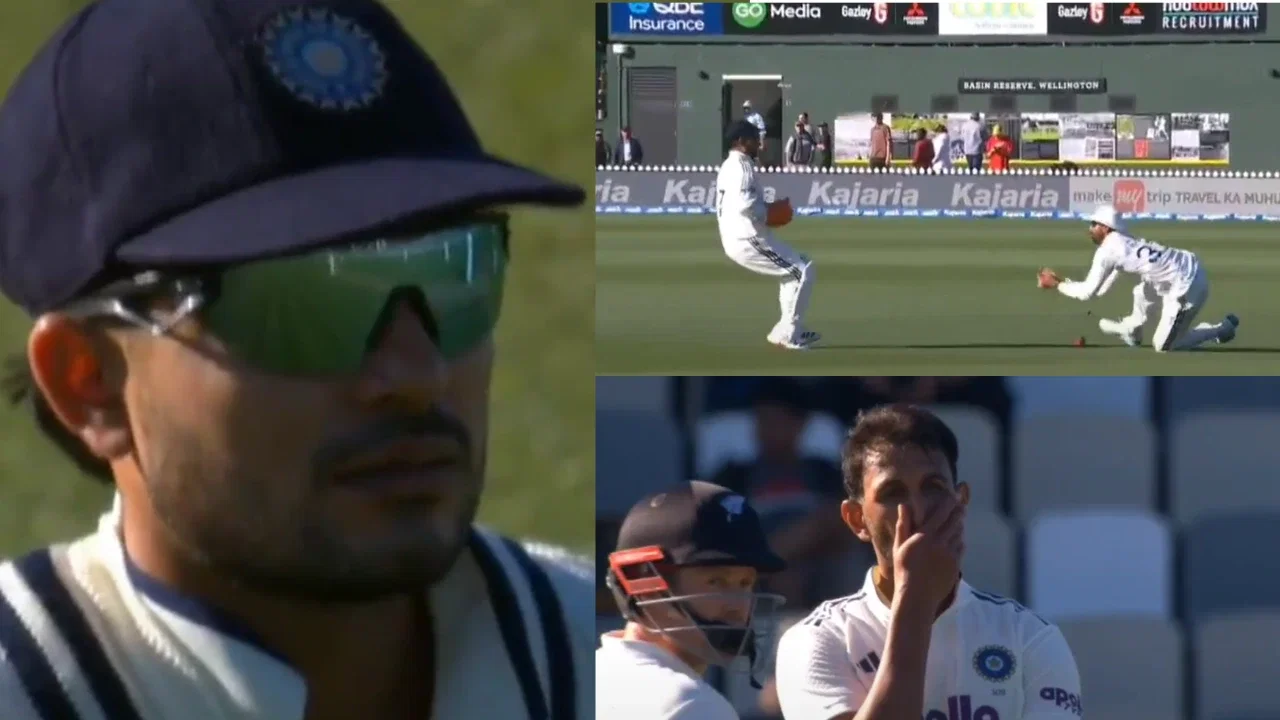
India’s Costly Fielding Mix-Up Gives Henry Nicholls a Lifeline at Basin Reserve
India captain Shubman Gill was left frustrated after a communication breakdown between Devdutt Padikkal and wicketkeeper Rishabh Pant cost the visitors a chance to dismiss Henry Nicholls during the first Test against New Zealand at Wellington’s Basin Reserve. The dropped catch came as India looked to halt a determined recovery from the hosts, who had been reduced to 70 for five after a powerful opening spell from Jasprit Bumrah.
Fast bowler Prasidh Krishna also reacted with visible disbelief when Padikkal failed to hold the chance at backward square leg. Nicholls was on 102 at the time, and the missed opportunity allowed New Zealand’s rebuilding effort to continue. In a match where early wickets had put India firmly on top, the incident offered a reminder of how quickly a single fielding error can alter the mood and momentum of a Test innings.
Confusion Between Padikkal and Pant Costs India a Catching Chance
The opportunity arrived in the 74th over, when Krishna bowled a short delivery that Nicholls attempted to pull. The shot was mistimed, and the ball came off the upper part of the bat, looping towards backward square leg. Padikkal was stationed in the area and appeared to have a clear chance to complete the catch.
Pant, however, moved away from the stumps and ran towards the ball. He checked his approach when he saw Padikkal closing in, but the hesitation disrupted the communication between the two fielders. Pant called “yours” only after Padikkal had momentarily stopped, while Padikkal then called “mine” and tried to reset his position.
By then, the fielder was off balance and could not get properly underneath the descending ball. He reached out with both hands and made contact with his fingertips, but the ball slipped through and landed safely in front of him. The chance was gone, along with India’s opportunity to end a partnership that was helping New Zealand recover.
Padikkal and Pant exchanged frustrated looks after the miscue. Krishna covered his face in disbelief, while Gill appeared visibly displeased. The moment quickly became a talking point among viewers, with the central question being not simply who had the better chance, but why the fielders’ calls came too late to establish clear ownership of the catch.
Why the Missed Chance Mattered
India’s bowlers had built pressure through a sequence of accurate deliveries and dot balls, and Nicholls’ wicket could have opened the door to another collapse. Instead, the left-hander received a reprieve after reaching three figures, giving him and Glenn Phillips more time to strengthen their stand.
In Test cricket, catches are particularly valuable when a side has already made early inroads. A batter who survives a difficult spell can settle, tire the bowlers and turn a manageable target into a substantial first-innings total. The incident also underlined the importance of decisive communication in the field: a clear, early call can be just as important as safe hands.
Henry Nicholls Adds Another Basin Reserve Century
Nicholls had brought up his 12th Test hundred shortly before the dropped chance, reaching the landmark in the 70th over from Krishna. He steered a back-of-a-length delivery towards backward square leg to complete a composed innings that had become central to New Zealand’s recovery.
The 35-year-old took 188 balls to reach three figures. After celebrating with Phillips, he removed his helmet and raised his bat to acknowledge the crowd, his teammates and family members watching at the ground. The century was his fifth in Test cricket at the Basin Reserve, achieved in 15 innings.
That record places Nicholls among the most prolific Test century-makers at the Wellington venue. Martin Crowe also scored five hundreds there, doing so in 17 innings, while Kane Williamson reached the same total in 30. Ross Taylor and John Wright each recorded three Test centuries at the ground.
Nicholls’ latest hundred also strengthened his position in New Zealand’s all-time list of Test centurions. His 12 centuries moved him level with Brendon McCullum and John Wright, and ahead of Nathan Astle’s 11. Williamson leads the national tally with 33 hundreds, followed by Taylor with 19, while Crowe and Tom Latham have 17 each.
Bumrah’s Early Strikes Put New Zealand Under Pressure
New Zealand’s innings began poorly after Gill won the toss and elected to bowl. Bumrah struck in the opening over, bowling captain Tom Latham for a duck and immediately giving India the start they wanted.
Anshul Kamboj then removed Devon Conway for four, before Akash Deep dismissed Rachin Ravindra for 15, with Pant taking the catch behind the stumps. Bumrah claimed his second wicket before the interval, sending Daryl Mitchell back for one after Yashasvi Jaiswal completed the catch.
New Zealand went to lunch at 60 for four, with Nicholls unbeaten on 29 and Tom Blundell on five. Bumrah continued to threaten after the break, dismissing Blundell for five, with Gill taking the catch at first slip. At 70 for five, the hosts were in danger of losing their innings quickly.
But Nicholls and Phillips responded with patience and purpose. Their partnership steadied the innings, forcing India to work harder for each breakthrough and shifting some of the pressure back onto the visitors. Nicholls anchored the stand, while Phillips provided support as New Zealand attempted to turn a difficult start into a competitive total.
Match Prediction: Fielding and Partnership Could Shape the Contest
The dropped catch does not determine the outcome of a Test, but it could prove significant if Nicholls and Phillips continue to add runs. India’s pace attack had already shown its ability to exploit the conditions, and the visitors will need to return to disciplined lines and lengths to break the partnership. New Zealand, meanwhile, will look to make the most of the reprieve and build a first-innings score that gives its bowlers something meaningful to defend.
For India, the immediate challenge is to stay composed and avoid letting frustration affect the quality of their cricket. For New Zealand, the priority is to convert survival into a substantial recovery. With the Basin Reserve offering an engaging contest between India’s fast bowlers and New Zealand’s middle order, the next spell could be crucial to the match’s direction—and to any prediction of which side will gain the upper hand.
Latest News

SA vs BAN Playing 11 Today, Live Streaming, Pitch & Weather: South Africa tour of Bangladesh 2026, 2nd Test

AUS vs ENG Playing 11 Today, Live Streaming, Pitch & Weather: England tour of Australia 2026, 2nd T20I

Blair Tickner ruled out of 2nd Test vs India, replacement named

Tim Paine and Justin Langer face fresh questions over Australia’s ball-tampering scandal

India tour of Bangladesh gets fresh hope as BCB confirms talks with BCCI

Tom Latham opens up on soft ball problem and saliva ban after draw against India

Ajinkya Rahane slams Tilak Varma for publicly criticising Shahbaz Ahmed after India A’s defeat

ICC to introduce IPL-style bat checks in international cricket

“Smiling Laughing doesn’t happen”: R Ashwin’s dig at India’s approach after draw vs New Zealand

“Not good enough for Test cricket”: Scott Styris, Sunil Gavaskar slam Wellington pitch

Dodda Ganesh declares India ‘out of WTC final race’ after Wellington Test draw

Ajinkya Rahane criticises Shubman Gill for abusing Akash Deep in 1st Test vs New Zealand

‘Why so many boundary riders?’ Dinesh Karthik questions Shubman Gill’s captaincy after Wellington Test

“I just want to enjoy my life”: Yash Dayal reflects on his return to cricket


