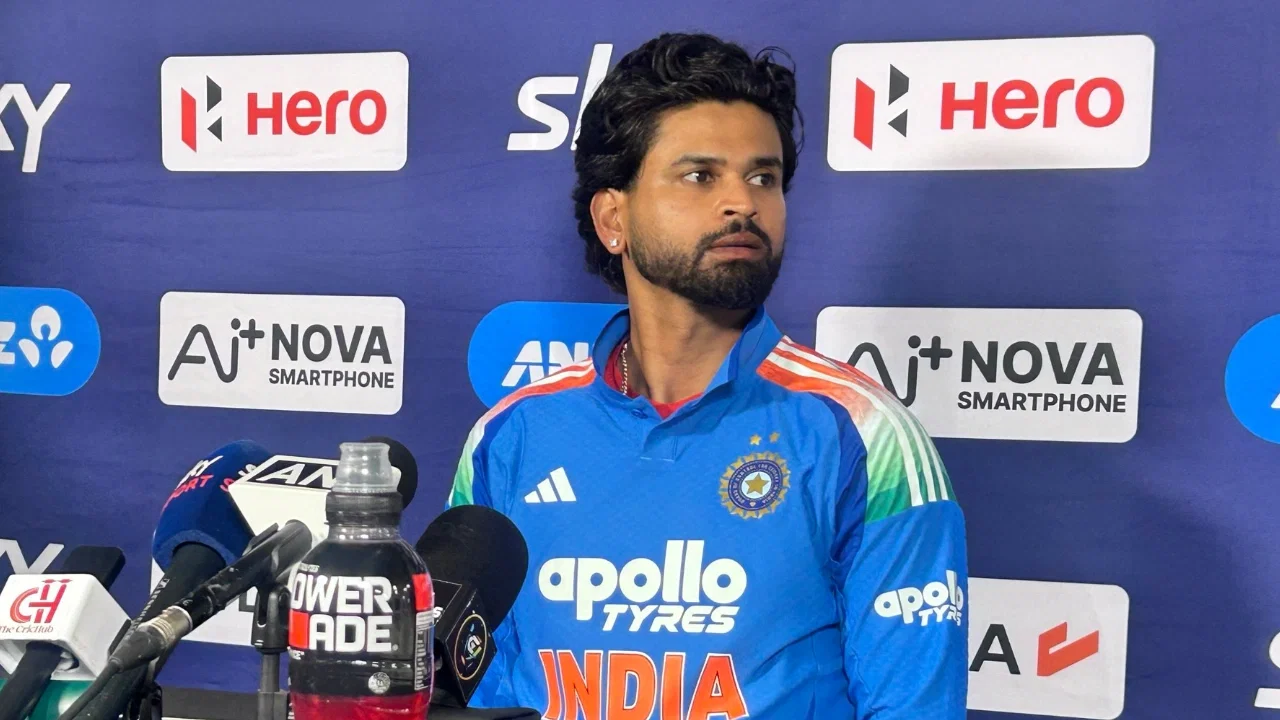
“It’s a great achievement”: Shreyas Iyer reacts as India complete ODI and T20I series double in New Zealand

India Beat New Zealand by 22 Runs to Complete Historic ODI and T20I Series Double
India secured a 22-run victory over New Zealand in the fifth ODI at Bay Oval in Mount Maunganui, defending a modest total in a tense, low-scoring finish. The result gave the Men in Blue another series win on New Zealand soil and marked the first time India had won both the ODI and T20I series during the same away tour of the country.
After the match, Shreyas Iyer praised India’s resilience, particularly the bowlers’ ability to deliver under pressure. He also noted that the conditions throughout the ODI series had made life difficult for batters, placing a premium on adaptability and disciplined bowling. India’s successful defence of 209 showed how quickly a match can turn when a team maintains belief, even after falling short of a commanding score.
India’s Middle Order Rescues a Difficult Innings
New Zealand captain Mitchell Santner won the toss and chose to field, hoping to exploit the conditions at Bay Oval. The hosts made two changes, bringing in Blair Tickner and Jacob Duffy for Matt Henry and Kyle Jamieson. India also adjusted its lineup: Kuldeep Yadav was left out, Yash Thakur made his ODI debut, and Mohammed Siraj returned in place of Gurnoor Brar.
India began steadily but soon lost two major figures. Rohit Sharma, whose struggles in New Zealand continued, was dismissed for seven. Virat Kohli followed for five, leaving the visitors under early pressure. Ruturaj Gaikwad looked composed at the crease but could not turn his promising start into a substantial score.
With wickets falling, India needed a partnership to prevent the innings from slipping away. Axar Patel and Ishan Kishan supplied it, each scoring 46. Their contributions helped India move beyond 100 and gave the lower order a platform to add valuable runs. Although neither batter reached a half-century, their stand proved central to India’s eventual total.
India were bowled out for 209, a score that looked vulnerable but remained competitive on a surface that offered assistance to the bowlers. Santner and Duffy led New Zealand’s attack, claiming three wickets apiece. The hosts had done well to restrict India, but their chase would soon reveal how challenging the conditions could be for a batting side.
Arshdeep Singh Leads India’s Match-Winning Bowling Effort
New Zealand made a promising start to the chase, but Siraj struck first by removing the dangerous Tim Seifert. Will Young and Nick Kelly then attempted to stabilise the innings, building a partnership that briefly gave the home side a foothold in the contest.
India’s bowlers responded by tightening their lines and applying pressure through the middle overs. Once the partnership was broken, New Zealand struggled to build another substantial stand. Wickets fell at regular intervals, forcing the lower order to take greater risks as the required runs mounted.
Arshdeep Singh was India’s standout performer, finishing with figures of 3 for 30 from his 10 overs. His disciplined spell helped prevent New Zealand from gaining momentum and kept the chase within India’s control. Siraj also made an important contribution by providing an early breakthrough, while the rest of the attack maintained pressure at crucial stages.
New Zealand came close enough to keep the contest alive, but India’s bowlers held their nerve and dismissed the hosts for 187. The 22-run margin reflected a match shaped by patience and execution rather than a high-scoring batting display. India’s defence also underlined the value of taking wickets at regular intervals when defending a total below 220.
Shreyas Iyer Reflects on India’s Historic Away Success
Speaking after the match, Iyer described India’s twin series victories as a significant achievement. The team had faced changing weather and different playing conditions across the ODI and T20I contests, requiring players to adjust their plans from match to match.
“Both the T20 and ODI series here came with different conditions. The weather kept changing, and we faced a lot of challenges. To come through successfully is a great achievement,” Iyer said, as quoted by Cricbuzz.
Iyer also highlighted the team’s belief during the final ODI. India’s total was not imposing, but the players remained confident that they could change the course of the match with the ball. That collective mindset, he suggested, helped the team stay focused rather than allowing the low score to dictate its approach.
“Even though we didn’t get that many runs, we still believed we could change the game at any point. I’m glad every individual thought in the same direction and we were able to execute that,” he added.
Bowling Depth Becomes a Defining Strength
Iyer’s assessment of the series reflected a broader lesson from the finale: India’s bowling depth proved decisive when batting conditions were difficult. He said the ODI contests had not generally favoured batters and praised the bowlers for responding to the challenge across the tour.
“If you look at the whole series, it wasn’t a series for batters. The way the bowlers performed, they stood up to the occasion and were confident they could get the team through, irrespective of the conditions,” Iyer said.
That confidence was evident in the fifth ODI. India’s bowlers did not need to defend a huge total; instead, they needed to stay patient, protect the scoring areas and make the most of each breakthrough. Their performance offered a useful reminder for teams facing low-scoring matches: a modest target can still be defended when the bowling unit applies pressure consistently and the fielding side remains composed.
India’s Series Win Offers Encouraging Signs
The result extended India’s success in New Zealand and added a notable milestone to the team’s away record. Winning both the ODI and T20I series on the same tour required contributions from different parts of the squad, including the middle order’s fight in the final match and the bowlers’ ability to close out a demanding chase.
For fans looking ahead, the key prediction from this performance is not simply that India can win low-scoring matches. It is that the team’s adaptability may remain a major asset when conditions are unpredictable. The fifth ODI showed that even after early batting setbacks, India could recover, set a defendable target and trust its attack to finish the job.
Latest News

ICC confirms future WTC finals and World Cup windows until 2035

“I have no further comments”: Cameron Bancroft responds to Usman Khawaja’s Sandpapergate remarks
‘Wasn’t getting the grip’: Sunil Gavaskar reveals why Mohammed Siraj took time to find rhythm
“Roko for maybe the last time”: Mitchell Santner confirms Virat Kohli and Rohit Sharma’s retirement
“It’s a great achievement”: Shreyas Iyer reacts as India complete ODI and T20I series double in New Zealand
Shreyas Iyer set for Syed Mushtaq Ali Trophy return after India’s series double in New Zealand

Ben Stokes ruled out of PSL 2027 as Multan Sultans confirm England star’s unavailability
Mitchell Santner opens up on his hand injury, credits Shreyas Iyer for India’s 3-1 ODI series win
“Never know what will happen”: Shreyas Iyer highlights key lessons for India ahead of 2027 ODI World Cup

Sam Billings returns as Dubai Capitals captain for ILT20 2026, set to miss BBL matches

“Has Been really grateful”: Arshdeep Singh credits fiancee Samreen Kaur after POTM performance vs New Zealand

“Calm and composed like MS Dhoni”: Uttarakhand head coach compares Lakshya Raichandani with former captain
Gautam Gambhir takes subtle dig at Rohit Sharma and Virat Kohli, says ‘bowlers win you series’

Dinesh Karthik credits Mohammed Siraj and Arshdeep Singh for India’s win vs NZ in 5th ODI