Mohammad Kaif slams treatment of Bhuvneshwar Kumar, compares him with Jasprit Bumrah
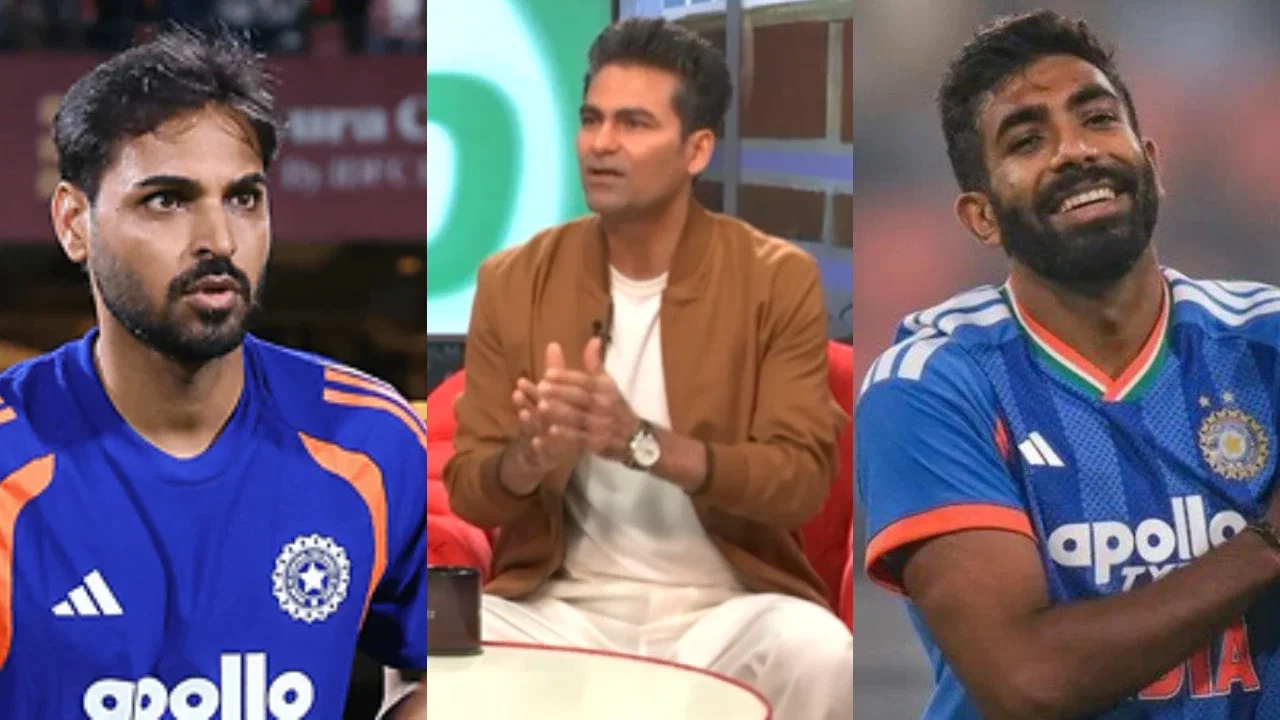
Mohammad Kaif Defends Bhuvneshwar Kumar, Says India’s Senior Pacer Was Unfairly Blamed
Former India batter Mohammad Kaif has come to Bhuvneshwar Kumar’s defence, arguing that the experienced fast bowler did not always receive fair treatment during his time in the national team. Kaif believes Bhuvneshwar was made a scapegoat after India’s heavy defeats at major T20 World Cups, even though the team’s batting failures also played a significant part.
The discussion has returned to the spotlight after Bhuvneshwar was recalled for India’s upcoming five-match T20I series against New Zealand. His comeback opportunity, however, was interrupted by the weather: the fifth and final T20I in Bengaluru was abandoned because of rain, leaving fans without a chance to see him back in action.
Speaking on Cricbuzz, Kaif highlighted Bhuvneshwar’s record, temperament and understated approach to the game. He also compared the seamer’s T20I numbers with those of Jasprit Bumrah, suggesting that the difference in public perception does not always reflect the closeness of their statistics.
Kaif Compares Bhuvneshwar Kumar’s T20I Record With Jasprit Bumrah’s
Kaif said Bhuvneshwar’s T20I economy rate is almost the same as Bumrah’s and described their overall figures as closely matched. His comments offer a reminder that judging a bowler by reputation alone can overlook the consistency and control required to succeed in the shortest format.
“Bhuvneshwar Kumar is a very solid and straightforward person who does not show off. He doesn’t have any flamboyance. His T20I economy rate is almost the same as Jasprit Bumrah’s, and their overall statistics are also very close,” Kaif said.
Kaif also praised Bhuvneshwar’s personality, portraying him as a quiet professional who lets his performances speak for themselves. That low-key image may have contributed to the way his contributions were discussed, particularly when India’s results fell short of expectations. In international cricket, high-profile defeats often lead to intense scrutiny, and bowlers can become easy targets when opponents score freely.
Still, a statistical comparison should not be mistaken for a claim that the two bowlers are identical. Bumrah and Bhuvneshwar bring different skills to a team, and their value depends on conditions, opposition and the role assigned to them. Kaif’s broader point is that Bhuvneshwar’s record deserves to be assessed fairly rather than reduced to a few difficult matches.
Why Kaif Says Bhuvneshwar Was Made a Scapegoat
Bhuvneshwar faced criticism after India lost to Pakistan by 10 wickets in the 2021 T20 World Cup Super 12 stage. The following year, India suffered another 10-wicket defeat, this time against England in the 2022 T20 World Cup semi-final at Adelaide Oval. Those results intensified questions about India’s bowling plans and the performance of individual players.
Kaif argues that the attention placed on Bhuvneshwar was disproportionate. He noted that India’s batters did not set sufficiently challenging targets in either match, leaving the bowlers with little margin for error. When a team posts a below-par total, opposition batters can play with greater freedom, making it harder for even experienced bowlers to build pressure.
“Even when Bhuvneshwar was dropped from the team, his performance was not bad. His record was good even then. But India lost to Pakistan by 10 wickets and later suffered another 10-wicket defeat against England in Australia, and the entire blame was put on Bhuvneshwar. However, he did not perform poorly there. Our batters also failed to put up competitive totals,” Kaif explained.
His comments raise a wider question about how cricket performances are evaluated after major losses. A bowler’s figures can be shaped by the total they are defending, the condition of the pitch, fielding support and the quality of the opposition. While individual mistakes should be examined, team results rarely have a single cause. Kaif’s assessment is that India’s batting struggles in those World Cup matches deserved equal consideration.
Different Strengths: Bumrah’s Pace and Bhuvneshwar’s Swing
Bumrah and Bhuvneshwar offer contrasting options for an India bowling attack. Bumrah is known for his unusual action, high pace, sharp bounce and precise yorkers. Those qualities allow him to challenge batters across all phases of a T20 innings: he can attack early, control the middle overs and deliver under pressure at the death.
Bhuvneshwar’s game is built around control, movement and subtle changes of pace. With the new ball, he can swing it both ways and target the stumps or edges, making him particularly dangerous during the powerplay. As the ball gets older, he can turn to slower deliveries, knuckleballs and wide yorkers to disrupt a batter’s timing.
That variety can be especially useful in conditions that offer movement through the air or assistance from the surface. It also gives a captain a different tactical option from a pace-first approach. Rather than viewing Bhuvneshwar and Bumrah as direct substitutes, teams can benefit from using their distinct strengths in complementary roles.
What Bhuvneshwar’s Recall Could Mean for India
Bhuvneshwar’s selection for the New Zealand T20I series signals that selectors remain open to bringing experience back into the bowling group. A senior player can offer more than overs and wickets: familiarity with international pressure, tactical awareness and the ability to guide younger teammates can also matter in a developing squad.
His abandoned comeback match in Bengaluru means the series did not provide the on-field evidence fans were hoping for. Any prediction about his place in India’s plans will therefore depend on future opportunities, his fitness and how the team balances swing bowling with pace and death-over options. The rain-affected fixture has only postponed the debate about what he can still contribute.
For Kaif, the central issue is not whether Bhuvneshwar should automatically be selected ahead of other bowlers. It is whether his career and performances are judged with the same care given to more celebrated names. His record, he argues, shows that the seamer remained effective even during periods when he was outside the team.
As India continue to shape their T20I attack, the discussion around Bhuvneshwar serves as a useful reminder: reputation, match conditions and team totals all influence how a performance looks. Kaif’s defence does not erase the difficult World Cup defeats, but it challenges the idea that one bowler alone should carry responsibility for them. For a player whose strengths rely on precision and movement, a fair assessment requires looking beyond the headline scoreline.
Latest News
Naveen-ul-Haq opens up on Gautam Gambhir’s advice during shoulder injury recovery
Ramesh Powar joins BCCI selection committee, Pragyan Ojha named chief selector
Mohammad Kaif slams treatment of Bhuvneshwar Kumar, compares him with Jasprit Bumrah
Aakash Chopra names 3 players Vaibhav Sooryavanshi can replace in India XI ahead of New Zealand tour
Sarfaraz Khan and Rajat Patidar dominate Ranji Trophy with stunning centuries
Justin Langer links Steve Smith, David Warner’s ball-tampering ban to decline of reverse swing in cricket
Jasprit Bumrah gets special treatment, Mohammed Shami gets snubbed? Mohammad Kaif demands explanation

MS Dhoni’s naughty move with Sakshi at Ambani family’s Navratri Mela goes viral
Chinmay Sutar joins Bhausaheb Nimbalkar in elite Ranji Trophy 400 club
PAK vs ENG Playing 11 Today, Live Streaming, Pitch & Weather: Pakistan vs England 2nd ODI, Tri-Series 2026
Lahore Qalandars owner keen to join BPL after discussions with Tamim Iqbal
Ravi Shastri wants Jasprit Bumrah to give up on one format until 2027 World Cup
Niki Prasad creates world record with two wickets in first 2 T20I balls
Watch: Gary Kirsten visibly furious after Dasun Shanaka’s dismissal against Pakistan, video viral