Zimbabwe become first team in Test history to score 500-plus in both innings, Zia-ur-Rehman records unwanted feat
Zimbabwe Make Test Cricket History With Two 500-Plus Innings Against Afghanistan
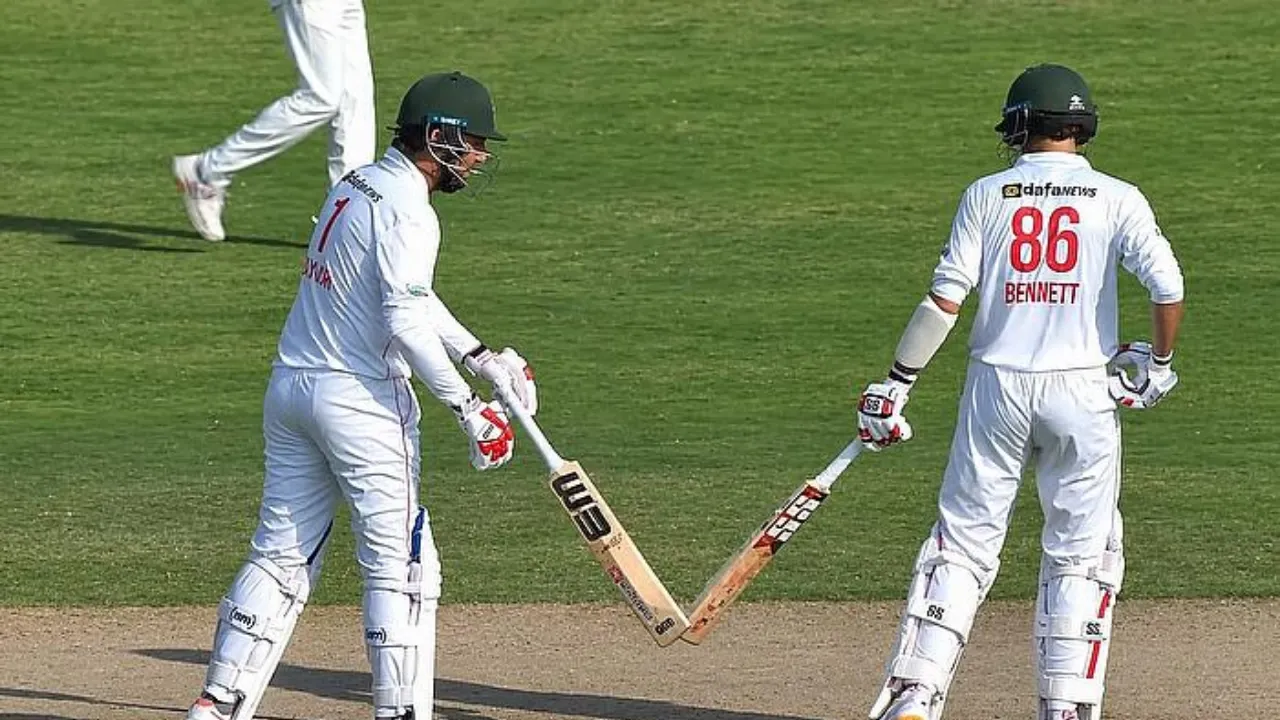
Zimbabwe have set a remarkable new benchmark in Test cricket, becoming the first team to score more than 500 runs in both innings of a single match. The milestone came in a memorable drawn first Test against Afghanistan at Sharjah Cricket Stadium, where Zimbabwe’s batters combined patience, resilience and record-breaking individual performances.
Led by Brian Bennett, Zimbabwe declared their first innings at 504 before reaching 523 for five in their second. Their marathon final-day effort left Afghanistan with no realistic chance of forcing a result and ensured the contest ended in a draw. The teams are scheduled to meet again at the same venue in the second Test, beginning November 13.
Zimbabwe’s Record-Breaking Second Innings
Zimbabwe resumed the fifth and final day at 164 for three, with captain Craig Ervine and Bennett at the crease. Bennett moved past fifty but was dismissed by Mohammad Saleem, who struck the top of the batter’s leg stump. His departure brought debutant Antum Naqvi in to join Ervine.
Naqvi made a valuable contribution under pressure, scoring 61 and sharing a 140-run partnership with Ervine for the fifth wicket. Abdul Malik eventually ended the stand by dismissing the debutant, but Afghanistan could not make further inroads into Zimbabwe’s batting line-up.
Wessly Madhevere joined Ervine and helped turn a strong position into a historic one. The pair batted through the remainder of the innings, adding an unbeaten 208 runs for the sixth wicket—the highest partnership for that wicket in Zimbabwe’s Test history. Zimbabwe closed on 523 for five after batting for more than 122 overs in the second innings.
The result was a landmark for a team that has often had to fight for consistency in the longest format. Scoring 500-plus twice in one Test reflects not only the quality of the individual innings, but also the concentration required to build a large first-innings total and then sustain another lengthy effort under match conditions.
Ervine’s Double Century and Madhevere’s Maiden Test Hundred
Ervine was the central figure in Zimbabwe’s second-innings surge. The left-hander finished unbeaten on 206 from 279 deliveries, striking 23 fours and two sixes. His innings blended controlled aggression with careful shot selection, allowing him to remain at the crease while the match moved into its final stages.
At 41 years and 82 days, Ervine became the third-oldest player to score a double century in Test cricket. Only South Africa’s Eric Rowan and England’s Jack Hobbs were older when they reached the milestone. The achievement added another notable chapter to a career defined by experience and composure at the crease.
Madhevere also had a day to remember, completing his maiden Test century. He reached his half-century at roughly a run per ball before shifting into a more measured approach. The change of tempo showed an awareness of the match situation: Zimbabwe were building a historic total, while Afghanistan needed wickets quickly to create any late opportunity.
Madhevere ended unbeaten on 100, sharing the record sixth-wicket stand with Ervine. For the 25-year-old, the century was a significant personal milestone; for Zimbabwe, it provided the assurance and partnership needed to bat out the contest.
Afghanistan’s Bowling Challenge and Match Prediction
Afghanistan captain Rahmat Shah faced a difficult balancing act as the innings wore on. With Zimbabwe’s batters well set and the frontline attack under pressure, he turned increasingly to part-time options and defensive spin during the afternoon and evening sessions. He also chose not to take the new ball, despite the old ball having lost much of its seam.
That approach reflected the challenge of trying to break a settled partnership on a surface where Zimbabwe’s batters had found a reliable rhythm. Ervine and Madhevere were able to manage the risk, rotate the strike and punish loose deliveries, leaving Afghanistan with limited chances to change the course of the match.
Looking ahead to the second Test, the first match offers a clear prediction: Afghanistan will need a more effective plan for taking wickets if they are to avoid another long day in the field. Zimbabwe, meanwhile, will take confidence from their batting depth and the form of Ervine, Madhevere and Naqvi. The next contest may depend on whether Afghanistan can create early pressure before Zimbabwe’s middle order settles in.
Zia-ur-Rehman Enters the Test Record Books for the Wrong Reason
Afghanistan spinner Zia-ur-Rehman endured an especially demanding match. He took two wickets in each innings but conceded 170 runs from 46 overs in the first and 173 from 50 overs in the second. His match figures of four for 343 rank as the third-most expensive in Test history.
Zia-ur-Rehman also became the first bowler to concede at least 150 runs in both innings of a Test. His total places him behind West Indies’ Tommy Scott, who gave away 374 runs against England in Kingston in 1930, and Australia’s Jason Krejza, who conceded 358 against India in Nagpur in 2008.
Another detail underlines the scale of the performance: among the seven instances of a bowler conceding more than 300 runs in a Test, Zia-ur-Rehman is the only one to finish with fewer than five wickets. The figures reflect the difficulty of bowling long spells against batters who were determined to occupy the crease and keep scoring.
The record for the most runs conceded in a single Test innings remains with Australia’s Chuck Fleetwood-Smith, who allowed 298 runs against England at The Oval in 1938. India’s Rajesh Chauhan follows with figures of one for 276 against Sri Lanka in Colombo in 1997.
A Landmark Draw With Lasting Significance
Although the Sharjah Test produced no winner, it delivered a result that will remain part of cricket history. Zimbabwe’s twin totals above 500, Ervine’s double century, Madhevere’s first Test hundred and the record sixth-wicket partnership made the draw an unusually eventful contest.
The match also sets up an intriguing second Test. Zimbabwe will aim to carry their batting confidence into the next game, while Afghanistan will look for sharper execution with the ball and a way to prevent long partnerships. After such a historic opening, the rematch promises a fresh test of patience, strategy and resilience for both sides.
Latest News

Top 10 biggest trade and transfer deals in IPL history, Hardik Pandya-Arshdeep Singh swap at No.3

Rohit Sharma goes MISSING in Hamilton amid IND vs NZ ODI series, here’s what happened next

IPL 2027: Ruturaj Gaikwad to remain CSK captain, Noor Ahmad set to stay
Michael Clarke calls out Pat Cummins over Usman Khawaja’s Sandpapergate revelations, seeks fresh probe

No Yashasvi Jaiswal to LSG as franchise finalizes core squad ahead of IPL 2027 auction
Australian Cricketers’ Association breaks silence on Usman Khawaja’s Sandpapergate claims

“IPL has earned the right to influence the calendar – KKR Co-owner Juhi Chawla proposes new window

Marnus Labuschagne reveals Test comeback plan after Australia axing
Usman Khawaja set to join Sky Sports’ broadcast team for next Ashes series

Mitchell Starc reacts to Usman Khawaja’s Sandpapergate revelations
Vaibhav Sooryavanshi accused of influencing Bihar T20 team selection ahead of SMAT 2026

IPL set for expansion to 12 teams in 2028, Pune and Vadodara among likely destinations
Arshdeep Singh’s father confirms Mumbai Indians move ahead of IPL announcement
Zimbabwe become first team in Test history to score 500-plus in both innings, Zia-ur-Rehman records unwanted feat