Why was the toss conducted twice in Jammu & Kashmir vs Vidarbha Ranji Trophy match; reason revealed
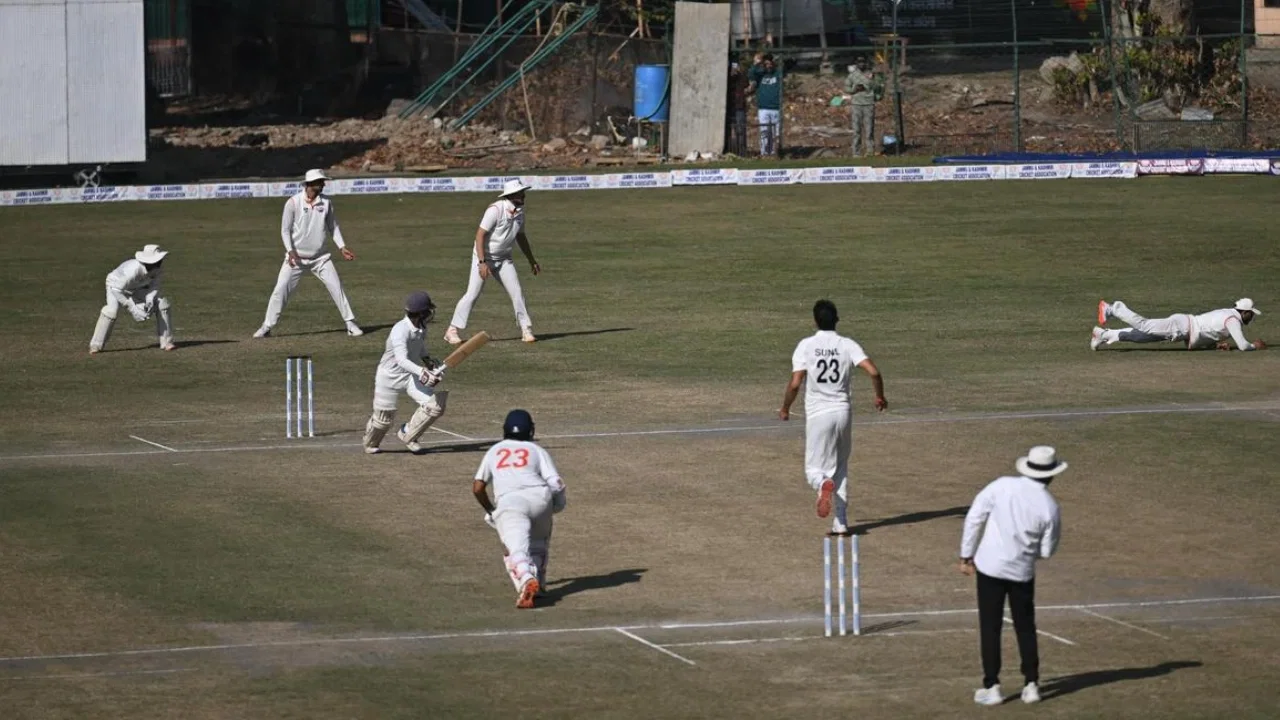
Ranji Trophy 2026–27: Rare Double Toss Adds an Unusual Twist to Jammu & Kashmir–Vidarbha Match
A rare procedural mix-up brought an unexpected talking point to the Ranji Trophy 2026–27 fixture between Jammu & Kashmir and Vidarbha: the toss had to be conducted twice. While a second toss is highly unusual in a first-class match, the repeat was prompted by an error in Jammu & Kashmir’s submitted team sheet and rules governing changes to a nominated playing XI.
The unusual start did not decide the contest. Vidarbha went on to win by three wickets in a low-scoring match at Sher-e-Kashmir Cricket Stadium in Srinagar, where disciplined bowling and a crucial first-innings century shaped the result. But the incident offered a reminder that even a routine pre-match formality can become significant when team nominations and playing conditions are involved.
Why Was the Toss Conducted Twice?
According to a report by Kashmir Sports Watch, Jammu & Kashmir’s team sheet reportedly listed one player’s name twice. The error came to light after the first toss, when Jammu & Kashmir had won and elected to field. Vidarbha’s team management noticed the problem and brought it to the attention of its captain.
Because the teams had already been nominated, the matter could not simply be treated as a minor paperwork correction. Under the BCCI’s men’s multi-day playing conditions, a player in the named playing XI cannot be replaced after nomination without the opposing captain’s consent. Clause 1.2.1 states: “No player (member of the playing eleven) may be changed after the nomination without the consent of the opposing captain.”
With the team-sheet issue raised, officials conducted the toss again. This time Vidarbha won and also chose to bowl first. The two teams therefore reached the same decision about the opening innings, but the second toss was required to address the procedural circumstances surrounding the submitted XI.
A paperwork error with match-day consequences
Team sheets are an essential part of match administration, particularly in multi-day cricket, where a confirmed playing XI establishes who is eligible to take part. A duplicate name can create uncertainty about whether the intended eleven players have been properly nominated. Rules requiring the opposing captain’s approval help protect both teams from unilateral changes after the toss.
The episode also highlights why captains, team managers and officials need to check nomination documents carefully before play begins. A small administrative oversight can prompt delays, clarification from match officials and, as in this case, a highly unusual repeat of one of cricket’s most familiar rituals.
How the Match Was Decided
Once play began, the focus shifted from the double toss to a tense, low-scoring contest dominated by the bowlers. Vidarbha’s Ravikumar Samarth supplied the standout batting performance in the first innings, scoring 143 from 202 balls. His substantial contribution gave Vidarbha an important platform in a match where runs were difficult to come by.
Jammu & Kashmir’s Sunil Kumar kept his side in the contest with an outstanding match return. He claimed four wickets in the first innings and followed it with another four in the second, finishing with eight wickets across the game. His sustained impact underlined how quickly the balance could shift on a surface where the bowlers had plenty to celebrate.
Vidarbha’s Nachiket Bhute was equally influential. He took three wickets in the first innings and five in the second, also ending with eight wickets in the match. With both sides’ bowlers repeatedly breaking partnerships, the game became a test of patience and composure rather than a high-scoring batting contest.
Harsh Dubey guides Vidarbha home
Vidarbha were set a target of 79 for victory. The modest chase was not entirely straightforward, as Jammu & Kashmir continued to take wickets and keep the pressure on. Vidarbha eventually reached the target for the loss of seven wickets, securing a three-wicket win.
Harsh Dubey remained unbeaten on 22 from 40 balls, providing the calm finish his team needed. In a chase where every dismissal increased the tension, his not-out contribution helped Vidarbha cross the line without allowing the contest to slip away.
Double Tosses Have Happened Before
Although the circumstances in Srinagar were unusual, a toss being repeated is not entirely without precedent in Indian cricket. During Qualifier 2 of the Indian Premier League between Gujarat Titans and Rajasthan Royals, the toss was held again after the match referee reportedly could not hear a captain’s call clearly amid the noise.
A similar issue arose at the 2011 World Cup final between India and Sri Lanka. Match referee Jeff Crowe did not hear Sri Lanka captain Kumar Sangakkara’s call properly, leading to a repeat of the toss. Those cases centred on communication and the difficulty of hearing a call. The Ranji Trophy incident, by contrast, was linked to a team-sheet error and the regulations governing nominated players.
That distinction makes the Jammu & Kashmir–Vidarbha episode particularly notable. It was not simply a case of a call being missed in a noisy stadium; the repeat followed a question about the playing XI and the conditions that apply once a team has submitted its nominations.
What the Incident Means for the Ranji Trophy
The double toss was a brief but memorable moment in a match ultimately defined by Samarth’s century, the outstanding wicket-taking performances of Sunil Kumar and Nachiket Bhute, and Vidarbha’s composed finish. It also demonstrated how competition rules can shape match-day decisions beyond the action on the field.
For fans following the Ranji Trophy, the incident is a reminder that the details behind a match matter. Toss decisions, team nominations and playing conditions all form part of the framework that ensures a fair contest. In this case, a rare administrative complication led to an equally rare repeat toss—before Vidarbha’s bowlers and lower-order resilience settled the outcome.
Any prediction about the match based solely on the toss would have missed the real story: Vidarbha’s first-innings batting foundation and the decisive work of its bowlers proved more influential than the unusual start. The result was a hard-fought three-wicket victory, delivered in a game where every run and wicket carried weight.
Latest News
Sanju Samson makes massive statement on social media noise after match-winning knock vs New Zealand
WTC Points Table after South Africa vs Australia 2nd Test, 2026
Renuka Singh Thakur ruled out of Zimbabwe ODI series, Jintimani Kalita gets call-up
Why was the toss conducted twice in Jammu & Kashmir vs Vidarbha Ranji Trophy match; reason revealed
Watch: Nitish Kumar Reddy suffers brain-fade, embarrasses himself with catch celebration off free-hit vs NZ
Tilak Varma labelled “fraud” as angry fans bash him for “one of the worst T20 knocks” in 1st NZ T20I
Abhishek Sharma breaks Rohit Sharma’s six-hitting record to go No. 1
Bangladesh spinner Aliss Al Islam reported for suspect bowling action after ODI debut
Joe Root scripts history with 8,000 ODI runs, joins elite international club
“Know exactly what they’re doing”: Shreyas Iyer praises India’s batters after record chase against New Zealand
Harry Brook scripts history, surpasses Shubman Gill with record-breaking double century
India’s highest T20I run-chases: Top 5 successful pursuits
“I like batting with him”: Sanju Samson explains his understanding with Abhishek Sharma after winning POTM
India bowlers create unwanted record against New Zealand in 1st T20I